What Is CinemaScope? How Panamorph Anamorphic Lenses Create a True Cinema Hall Experience at Home
CinemaScope represents one of the most significant technological advancements in motion picture history. Introduced in the early 1950s, it transformed how films were experienced by offering a dramatically wider visual canvas than traditional formats. Even today, CinemaScope continues to define premium cinematic presentation, with most Hollywood films produced in ultra-wide aspect ratios such as 2.35:1 or 2.40:1.
In luxury residential environments, CinemaScope is not merely a display choice—it is a design philosophy. Achieving an authentic CinemaScope experience at home requires precision-engineered projection systems, advanced optical components, and expert system integration. Professional home theatre design and installation services in India play a crucial role in translating this cinema-grade technology into refined residential spaces.
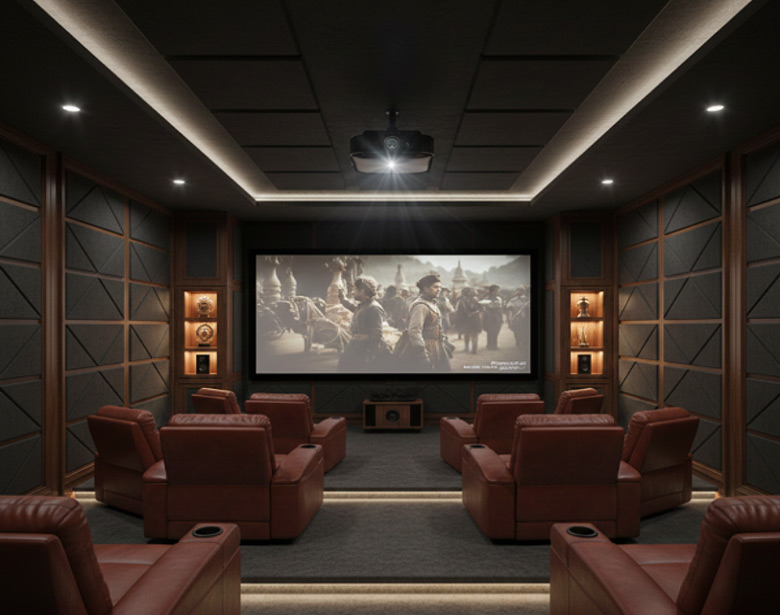
Modern luxury homes increasingly prefer large-screen projection in living rooms instead of oversized televisions. The challenge, however, is ambient light.
Explore professional solutions :
What Is CinemaScope?
CinemaScope is a widescreen film format that uses anamorphic optics to display images far wider than standard television formats. Unlike conventional 16:9 (1.78:1) screens, CinemaScope operates at approximately 2.35:1 or 2.40:1, allowing filmmakers to create expansive compositions with greater visual depth.
The defining principle behind CinemaScope is anamorphic image compression. During filming and projection, specialised lenses compress and later expand the image, enabling a wider picture without sacrificing resolution. This technique remains the foundation of modern cinematic projection.
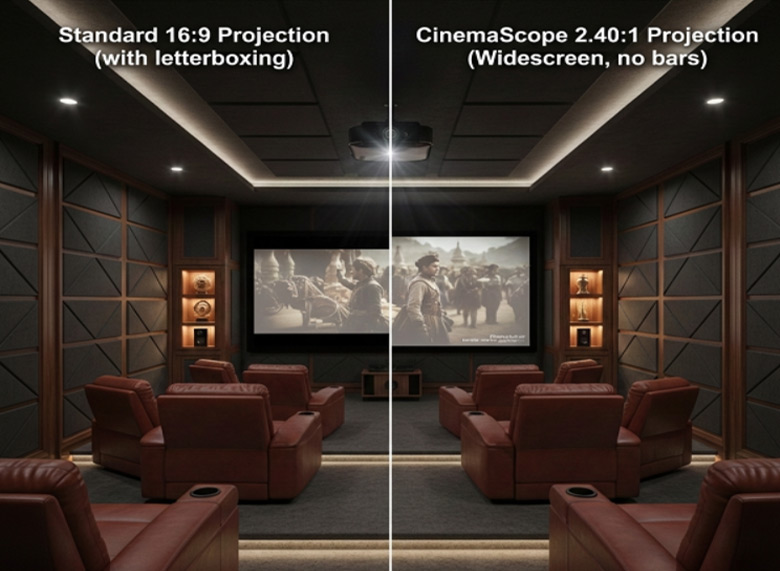
Standard 16:9 Projection vs CinemaScope Projection
Limitations of 16:9 Projection
Most residential projectors are built around 16:9 imaging chips. When widescreen cinematic content is displayed without anamorphic optics:
- Black bars appear above and below the image
- Up to 30% of projector pixels remain unused
- Overall brightness is reduced
- The cinematic field of view is compromised
This approach relies on digital zooming, which does not reflect the original cinematic intent.
CinemaScope Projection Advantage
CinemaScope projection uses a dedicated 2.40:1 screen combined with anamorphic processing to ensure:
- Full utilization of the projector’s imaging panel
- Higher brightness and contrast
- Greater perceived image sharpness
- A viewing experience that mirrors commercial cinema standards
What Is an Anamorphic Lens?
An anamorphic lens is a precision optical component mounted in front of the projector lens. Its purpose is to horizontally expand or compress the image without altering vertical resolution.
In CinemaScope systems, the projector first stretches the image vertically using internal scaling or an external processor. The anamorphic lens then restores the correct aspect ratio optically, allowing the entire pixel array to contribute to the image.
This optical process eliminates wasted resolution and delivers a visibly brighter, more immersive picture.
Why Panamorph Anamorphic Lenses Are Essential
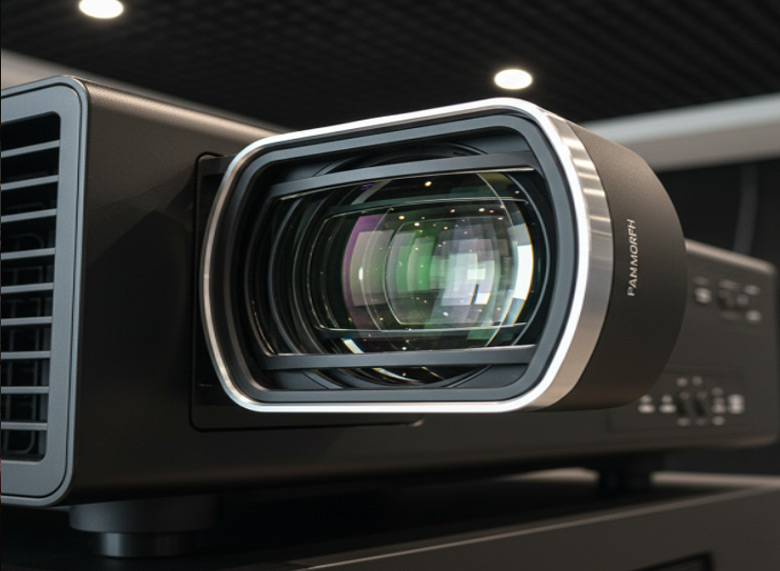
Panamorph is widely recognised as a leader in anamorphic projection technology for high-end residential cinemas. Their lenses are engineered specifically for premium home theatre environments.
Key Benefits of Panamorph Lenses
- Approximately 30% increase in on-screen brightness
- Full use of 4K or 1080p projector resolution
- Enhanced image detail and clarity
- Reduced pixel visibility on large-format screens
For homeowners seeking a true cinema hall experience, Panamorph lenses are not an upgrade—they are a necessity.
Role of Video Processors: Lumagen Integration
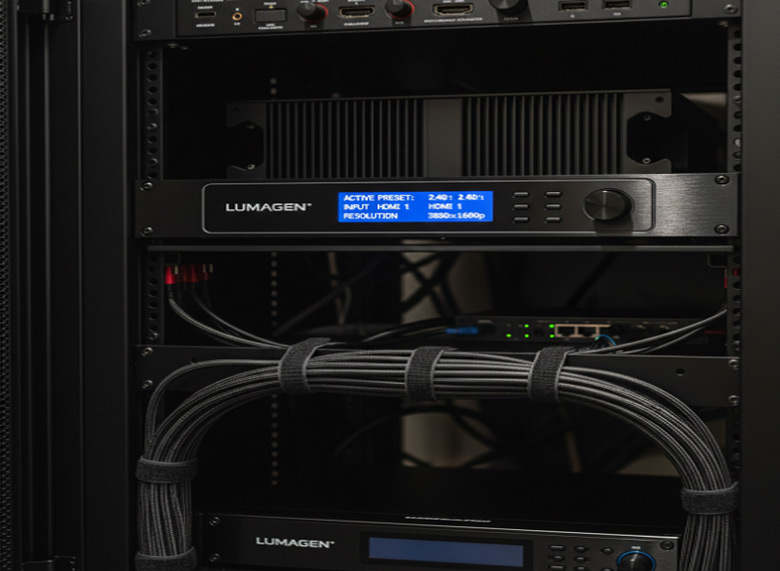
High-end CinemaScope systems often incorporate Lumagen video processors to manage scaling, geometry correction, and HDR tone mapping.
Lumagen processors ensure:
- Accurate vertical stretch for anamorphic projection
- Seamless switching between CinemaScope and 16:9 content
- Superior color accuracy and contrast control
When combined with Panamorph lenses, they deliver reference-grade image precision.
Compatible Projectors for CinemaScope Systems
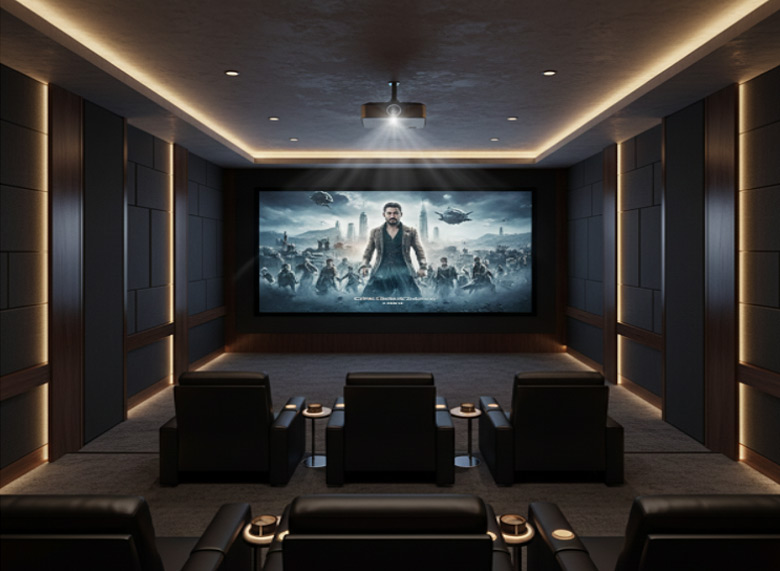
CinemaScope projection demands high-performance projectors capable of delivering brightness, contrast, and lens precision. Commonly used projector brands include:
- JVC – Industry-leading contrast and black levels
- SIM2 – Ultra-luxury Italian-made cinema projectors
- High-end Optoma models – Scalable solutions across performance tiers
Selecting the correct projector is a critical step in luxury home theatre consultation.
CinemaScope Screens: Completing the System
A CinemaScope setup requires a dedicated 2.40:1 aspect ratio screen. These screens are wider than standard formats and optimised for anamorphic projection.
Premium screens offer:
- Acoustically transparent materials
- Advanced light-control surfaces
- Fixed-frame designs for dedicated theatre rooms
Screen selection must consider room dimensions, seating distance, and ambient light conditions.
CinemaScope in Indian Luxury Homes
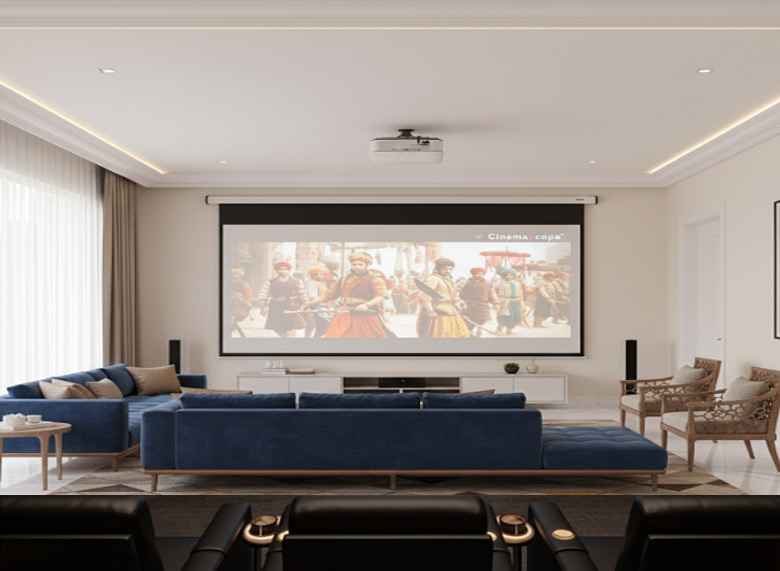
Dedicated Home Theatre Rooms
CinemaScope systems perform best in dedicated theatre rooms where lighting, acoustics, and seating can be fully controlled. These environments allow for:
- Larger screen sizes
- Optimal projector placement
- Fixed anamorphic lens alignment
Media Rooms and Hybrid Spaces
With professional planning, CinemaScope projection can also be integrated into media rooms, provided that light control and layout are addressed early in the design phase.
How CinemaScope Replicates the Commercial Cinema Experience
Commercial cinemas rely on ultra-wide screens and anamorphic optics—not 16:9 displays. By adopting the same principles at home, CinemaScope systems deliver:
- A dramatically wider field of view
- Enhanced immersion and realism
- Accurate framing as intended by filmmakers
CinemaScope is not an enhancement—it is the correct presentation format for cinematic content.
Conclusion
CinemaScope represents the pinnacle of cinematic presentation in residential environments. When combined with Panamorph anamorphic lenses, Lumagen video processors, and premium projection systems, it transforms a home theatre into a true private cinema.
For homeowners seeking uncompromised visual realism, CinemaScope sets the benchmark for luxury home theatre experiences.
Frequently Asked Questions (FAQs)
1. Is CinemaScope suitable for all home theatres?
CinemaScope is best suited for dedicated or high-end media rooms where screen size, projector placement, and lighting can be carefully controlled.
2. Does an anamorphic lens work with 4K projectors?
Yes. Panamorph lenses are designed to fully support 4K projection, preserving resolution and brightness.
3. Can 16:9 content still be viewed on a CinemaScope screen?
Yes. Modern processors allow seamless switching between aspect ratios with minimal compromise.
4. Is an anamorphic lens better than zooming the projector?
Yes. Optical anamorphic lenses preserve resolution, brightness, and image integrity, unlike digital zooming.
5. Does CinemaScope require professional installation?
Absolutely. Proper alignment, calibration, and system integration are critical for optimal performance.