
Dolby Atmos vs DTS:X vs Auro-3D: Which Immersive Audio Format is Best for Your Home Theatre in India?
Dolby Atmos vs DTS:X vs Auro-3D three of the most powerful immersive 3D audio formats ever created for home theatres. Each one promises to dissolve the walls of your cinema room and surround you with sound that moves above, below, and all around you with breathtaking realism. But they are not the same. They use different technologies, different speaker layouts, and they serve different audiences and understanding those differences is essential before investing in a luxury home theatre in India.
India’s home theatre market in 2026 is dominated by Dolby Atmos. You hear it daily on Netflix, Disney+, and Apple TV+. Yet DTS:X is a genuinely capable alternative that earns its place in serious AV discussions. And Auro-3D, the least-known of the three, is arguably the most acoustically pure format for music lovers and high-end villa cinema installations supported by processors like the StormAudio and Trinnov that Sound Innovators specifies in its most demanding luxury projects.
In this definitive guide, we cover all three formats in depth, compare them fairly and honestly across every dimension that matters, and give you a clear, practical verdict for Indian home theatre owners at every budget level. Furthermore, we tell you exactly which format Sound Innovators recommends and why.
- 01From Flat Surround to 3D Sound: Why Immersive Audio Formats Exist
- 02Dolby Atmos — The Market Leader
- 03DTS:X — The Flexible Challenger
- 04Auro-3D — The Audiophile’s Hidden Gem
- 05Complete Comparison Table
- 06Head-to-Head Verdicts
- 07Which Format is Right for Your Home
- 08What Equipment You Need for Each Format
- 09Frequently Asked Questions
From Flat Surround to 3D Sound: Why Immersive Audio Formats Exist
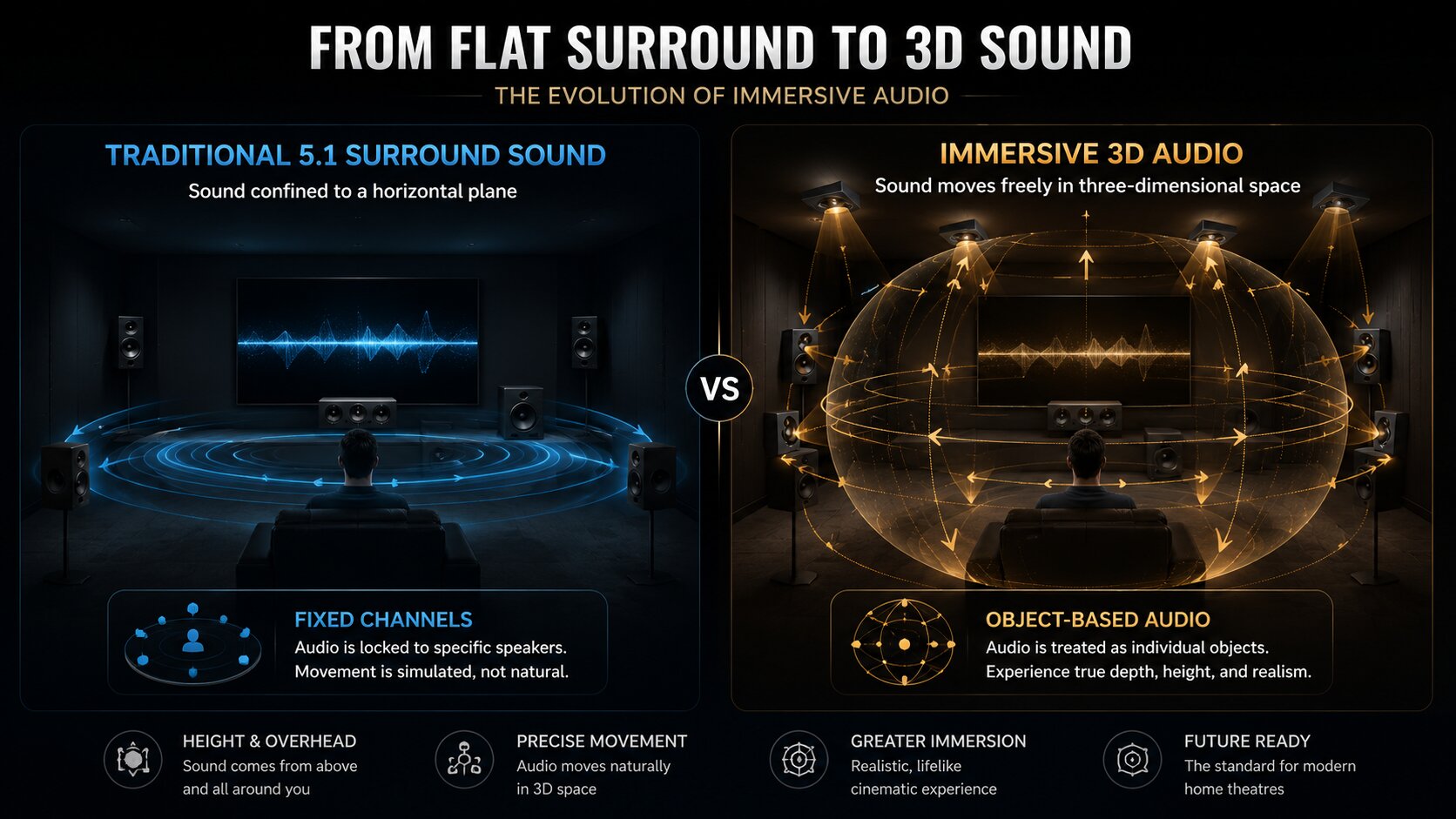
Difference between traditional surround sound and immersive 3D audio home theatre systems
Traditional surround sound formats Dolby Digital 5.1, DTS-HD Master Audio 7.1 lock every sound to a fixed speaker channel. The front-left speaker plays the front-left track. The rear-right plays the rear-right track. A helicopter crossing the sky diagonally can only be approximated by fading between channels, an effect that sounds artificial, particularly in a dedicated cinema room with widely spaced speakers.
The breakthrough that Dolby Atmos, DTS:X, and Auro-3D all represent in their different ways is the addition of a vertical dimension. Sound no longer just moves horizontally around you. It moves above you, descends from the ceiling, rises from the floor level, and travels diagonally through three-dimensional space. The difference between a good 7.1 system and a good 7.4.4 channel system is not incremental. It is categorical.
Dolby Atmos, DTS:X, and Auro-3D all add height channels to the traditional horizontal surround sound layout.
All three use overhead or height speakers to create a three-dimensional sound envelope above and around the listener.
Dolby Atmos, DTS:X, and Auro-3D all add height channels to the traditional horizontal surround sound layout.
All three use overhead or height speakers to create a three-dimensional sound envelope above and around the listener.
All three are supported by the same generation of premium AV processors including the StormAudio ISP Elite and Trinnov Altitude32 that Sound Innovators install in dedicated theater rooms.
The difference is HOW each format adds that height dimension and consequently what speaker layout, what content, and what listening experience each one delivers.
Dolby Atmos — The Market Leader
Introduced: 2012 (cinema), 2014 (home) | Developer: Dolby Laboratories, USA
Architecture: Object-based audio (up to 128 audio objects per scene)
Lossless Container: Dolby TrueHD on Blu-ray (up to 18 Mbps)
Max Speaker Config: 7.1.6 for home; no hard limit in cinema
India Streaming: Netflix, Disney+, Apple TV+, Amazon Prime — all major platforms
How Dolby Atmos Works
Dolby Atmos treats every sound in a film, concert, or game as an independent audio object. A helicopter, a raindrop, a whisper each is encoded with its own positional metadata describing where it should be in three-dimensional space. Your AV processor reads this metadata in real time and calculates exactly which combination of your speakers best reproduces that position, updating continuously as the sound moves.
TThe result is sound that travels freely through three-dimensional space above, beside, behind, and diagonally across the room with a precision and realism that fixed-channel audio cannot approach. Moreover, because Dolby Atmos is object-based, the same soundtrack renders correctly on a simple 5.1.2 living room system and on a 7.4.4 dedicated home cinema system the processor simply maps the objects to whatever speakers are present.
Dolby Atmos Speaker Layout
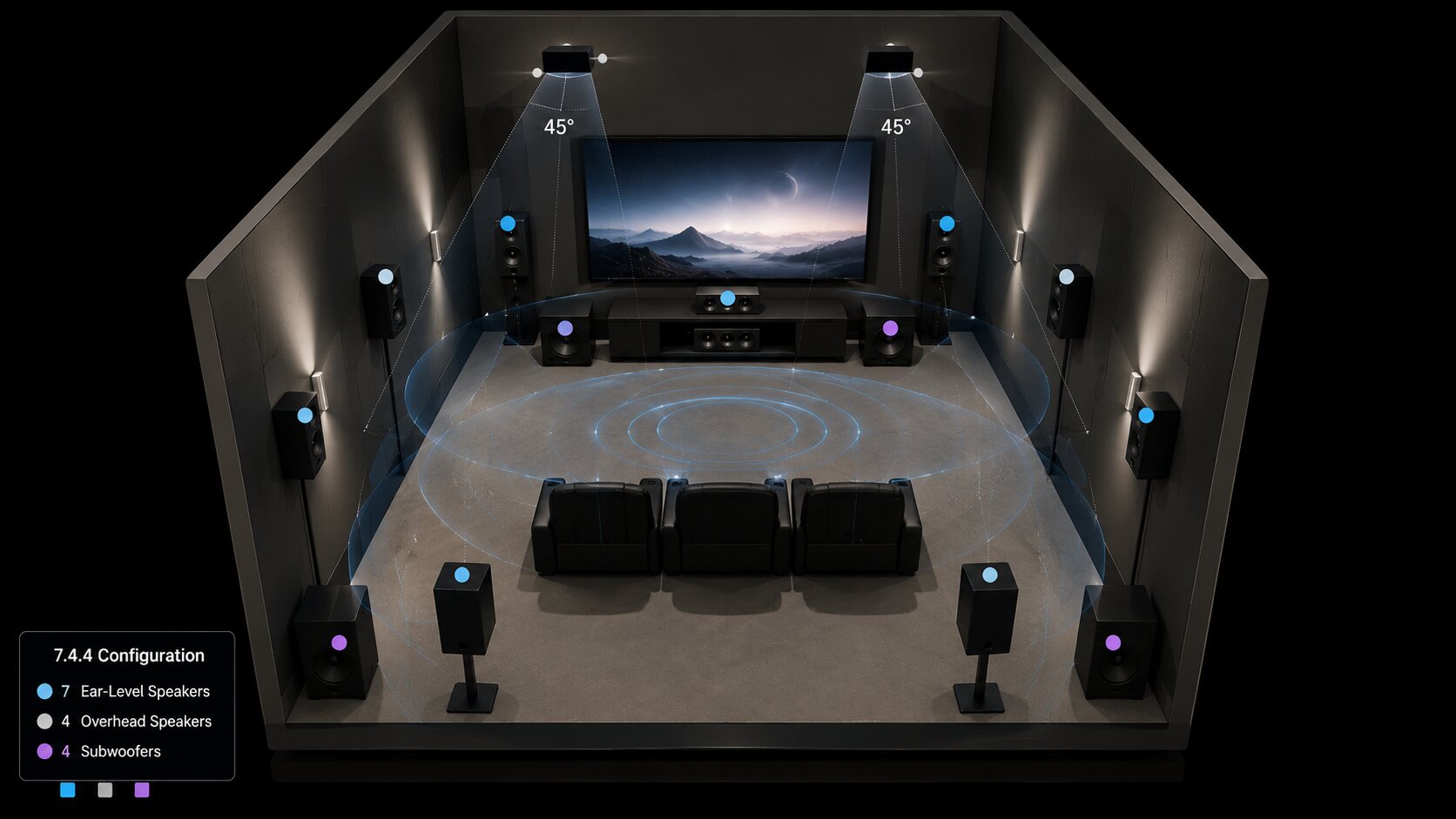
Dolby Atmos 7.4.4 speaker placement layout for luxury home theatre in India
| Configuration | Ear-Level Speakers | Subwoofers | Top Speakers |
|---|---|---|---|
| 5.1.2 | 5 | 1 | 2 |
| 7.1.2 | 7 | 1 | 2 |
| 7.1.4 | 7 | 1 | 4 |
| 7.2.4 | 7 | 2 | 4 |
| 7.4.4 | 7 | 4 | 4 |
| 9.4.6 | 9 | 4 | 6 |
| NOTE: Subwoofer numbers are determined based on room acoustics, specifically to minimize null points and achieve uniform low-frequency distribution. | |||
← Scroll table on mobile →
Dolby Atmos — Strengths
→
Dominant content library: Thousands of titles on Netflix India, Disney+ Hotstar, Apple TV+, Amazon Prime every major Indian streaming platform carries Dolby Atmos.
→
Studio standard: 90%+ of Hollywood films are mixed in Dolby Atmos first. Indian films from Bollywood to Tamil and Telugu blockbusters increasingly use Dolby Atmos theatrical mixes.
→
Universal hardware support: Every AV receiver above ₹65,000 sold in India today decodes Dolby Atmos. It is the universal baseline.
→
Backwards compatibility: Atmos tracks play as standard Dolby TrueHD on older equipment and you never lose access to the audio.
→
Flexible speaker layouts: Works with everything from a 5.1.2 system in a flat to a 7.4.4 reference villa cinema.
Dolby Atmos — Limitations
→
No user-adjustable dialogue: Dialogue level is fixed in the Atmos mix. You cannot increase the centre channel independently without a separate receiver feature.
→
Speaker placement guidelines: Speaker placement guidelines: Dolby recommends specific overhead speaker positions deviating significantly from these to reduce the effectiveness of the height rendering.
Sound Innovators’ definitive guide to 7.4.4 Dolby Atmos speaker placement covering all 15 speaker positions, ceiling angles, subwoofer arrays, and villa-specific acoustic challenges.
DTS:X — The Flexible Challenger
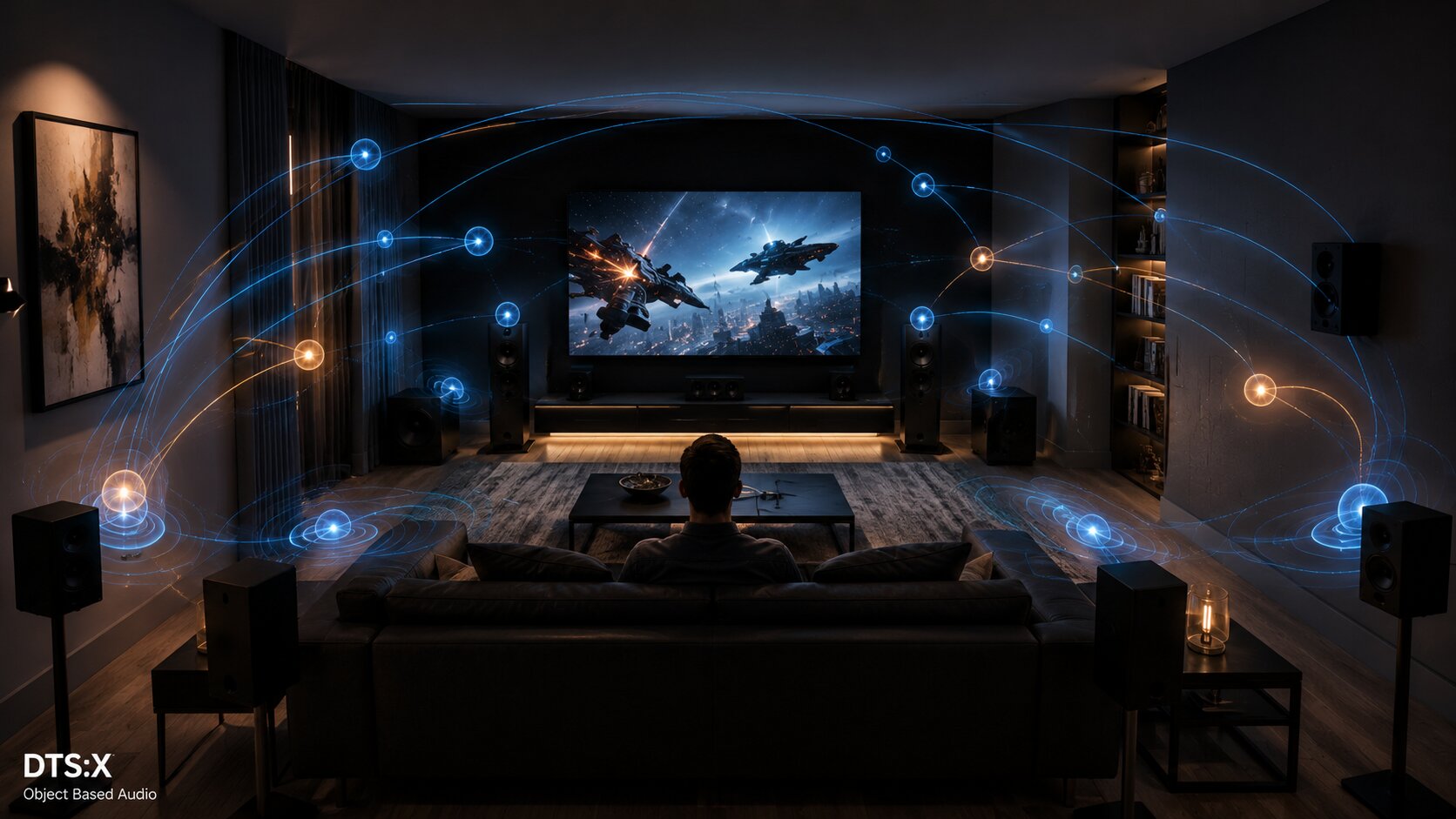
DTS:X object-based audio adapting to flexible home theatre speaker layouts
Introduced: 2015 (home first, then cinema) | Developer: DTS Inc., USA
Architecture: Object-based audio (no hard object limit; up to 32 speaker outputs for home)
Lossless Container: DTS-HD Master Audio on Blu-ray (up to 24.5 Mbps)
Max Speaker Config: Adapts to any layout — no minimum or maximum requirement
India Streaming: Limited — some Amazon Prime titles; absent from Netflix, Disney+, Apple TV+
How DTS:X Works
Like Dolby Atmos, DTS:X is an object-based audio format; sounds are encoded with positional metadata rather than being fixed to channels. However, DTS:X distinguishes itself through its Neural Mapping technology, which dynamically remaps audio objects to whatever speaker configuration you have, without requiring any specific layout.
The practical implication is significant: a DTS:X soundtrack will render on a standard 7.1 system without any ceiling speakers, and it will also render on a 7.4.4 system with four ceiling speakers adapting intelligently to whatever speakers are present. Furthermore, DTS:X preserves the dialogue as an independently addressable object, allowing users to adjust the dialogue level separately from the rest of the mix.
DTS:X — Strengths
→
Maximum speaker flexibility: Works with any configuration without requiring overhead speakers. No minimum layout requirement — unlike Atmos, you will not lose a dimension simply because your room lacks ceiling speakers.
→
Higher container bit-rate: DTS-HD Master Audio on Blu-ray supports up to 24.5 Mbps higher than Dolby TrueHD. Both are lossless, but DTS uses a less compressed algorithm
→
User-adjustable dialogue: The centre channel dialogue level can be independently raised by the user, a genuinely useful feature for late-night viewing, large families, or rooms with acoustic challenges.
→
All AV receivers that decode Dolby Atmos also decode DTS:X no additional hardware cost is required to support both formats simultaneously.
DTS:X — Limitations
→
Minimal India streaming presence: Minimal India streaming presence: DTS:X is essentially absent from Indian streaming platforms. Netflix, Disney+, and Apple TV+ do not carry DTS:X making it irrelevant for the majority of Indian daily viewing habits.
→
Smaller content library: On 4K Blu-ray, DTS:X has a respectable but significantly smaller library than Dolby Atmos. Most major studio releases choose Atmos as the primary immersive track.
→
Less studio adoption: The majority of film sound designers work primarily in Dolby Atmos. When a DTS:X track exists on a Blu-ray, it is frequently derived from the Atmos master rather than independently mixed.
Auro-3D — The Audiophile’s Hidden Gem
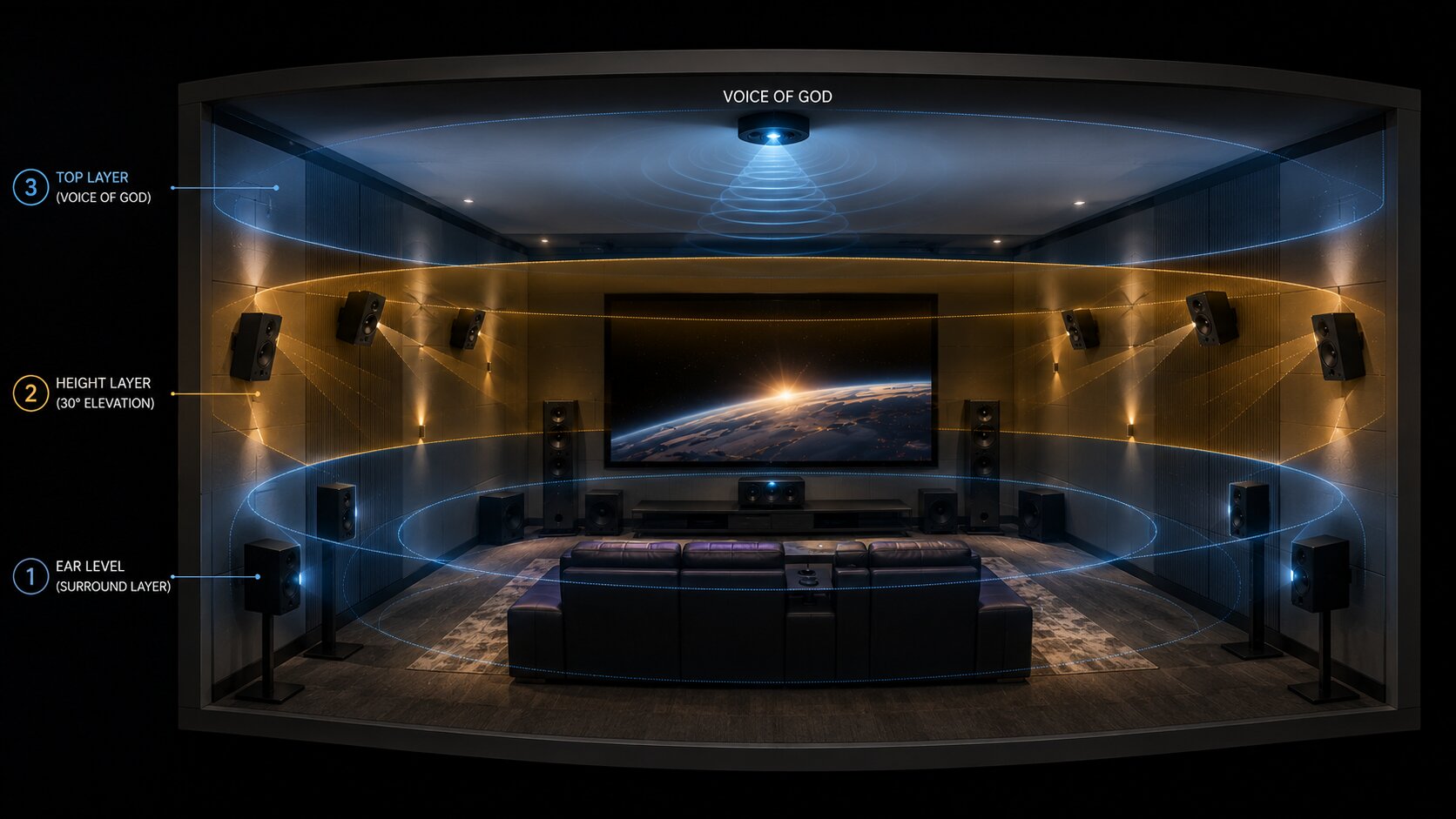
Auro-3D three-layer speaker layout with Voice of God channel for home theatre
Introduced: 2010 (cinema), 2012 (home) | Developer: Galaxy Studios / Auro Technologies, Belgium
Architecture: Channel-based (up to 13.1 channels in three vertical layers); Auromax adds object-based
Lossless Container: PCM or DTS-HD MA encoded; decoded by compatible processors
Max Speaker Config: Auro 13.1 (ear-level + height layer + Voice of God ceiling channel)
India Streaming: Not available on any Indian streaming platform
How Auro-3D Works — The Three-Layer Philosophy
Auro-3D takes a fundamentally different approach to the other two formats. Rather than treating audio as free-floating objects in three-dimensional space, Auro-3D organises sound into three distinct vertical layers — each representing a natural acoustic layer of the real world:
Standard 5.1 or 7.1 speaker configuration at seated ear height. This is the foundation the same horizontal surround sound layer that traditional formats use.
Speakers mounted on the walls at approximately 30 degrees elevation from the listener’s ear level not in the ceiling, but on the wall above the ear-level speakers. This height layer is Auro-3D’s defining innovation and the layer that carries the most acoustically significant immersive information.
A single centre ceiling speaker directly overhead the “Voice of God” channel. This is the topmost layer, representing sounds from directly above. It is optional in smaller rooms but essential for the full Auro 13.1 experience in larger villa cinema rooms with two or more seating rows.
The resulting Auro 13.1 speaker configuration 7 ear-level + 5 height + 1 ceiling + 1 low subwoofer = 13.1 creates what Auro Technologies describes as a “natural sound bubble,” replicating the way sound actually behaves in a real acoustic environment. The height layer at 30 degrees, in particular, is positioned at the elevation where the human ear is most sensitive to directional audio information.
The Critical Auro-3D Speaker Layout Difference
Dolby Atmos and DTS:X place their height speakers in or on the ceiling typically at 45 degrees above the listening position.
Auro-3D places its height speakers on the WALL at approximately 30 degrees elevation not in the ceiling. Only the single Voice of God channel is truly overhead.
This is a meaningful acoustic difference. Auro Technologies argues that the wall-mounted height position at 30 degrees is where the human ear is most sensitive to vertical sound directivity and that ceiling-only placement misses the most acoustically rich elevation.
The implication for dedicated theater room: a room optimised for Auro-3D has wall-mounted height speakers at 30 degrees and a single ceiling speaker. A room optimised for Dolby Atmos has ceiling speakers at 45 degrees. These are different positions meaning a hybrid room requires careful planning.
Auro-3D — Strengths
→
Auro-3D was designed from the ground up with music as well as film in mind. The Automatic upmixer widely regarded as the finest music upmixer available transforms any stereo or 5.1 music source into a natural, immersive three-dimensional soundfield. For hi-fi music listeners, Auro-3D has no equal.
→
Hi-Res audio in all channels: Auro-3D is the only immersive format that supports high-resolution audio (up to 96kHz) in every channel simultaneously including the height and ceiling layers. Dolby Atmos and DTS:X support hi-res in the height channels but are limited to 48kHz for the bed channels.
→
Natural acoustic philosophy: The three-layer approach more closely mirrors how sound actually propagates in a real acoustic environment; many audiophiles and sound engineers describe the Auro-3D experience as more natural and less processed than object-based formats.
→
Pure Audio Blu-ray: Auro-3D pioneered the Pure Audio Blu-ray format dedicated audio-only discs with music content at up to 24-bit/192kHz resolution in Auro-3D and Dolby Atmos. An extraordinary format for serious music listeners.
Auro-3D — Limitations
→
Extremely limited content: Auro-3D’s content library is the smallest of the three dominated by live concert recordings and European film releases. There is essentially no Indian content available in Auro-3D, and no Indian streaming service carries it.
<
→
Requires specific processor: Not all AV receivers support Auro-3D. It requires a compatible processor such as the Trinnov Altitude, or StormAudio ISP (with optional Auro-3D licence). This adds cost and complexity compared to Dolby Atmos and DTS:X.
→
Speaker placement conflict with Atmos: Because Auro-3D uses wall-mounted height speakers at 30 degrees while Atmos uses ceiling speakers at 45 degrees, optimising a room for both simultaneously requires careful planning and sometimes compromise on both.
→
Niche audience: Auro-3D is primarily relevant for serious audiophiles and music enthusiasts. For the Indian home theatre market where film and streaming content dominates, Auro-3D is a premium add-on rather than a primary format.
If Auro-3D’s music reproduction capability appeals to you, explore how Sound Innovators designs dedicated hi-fi listening rooms and multi-room audio systems alongside your home theatre.
“Dolby Atmos moves the cinema into your home. DTS:X adapts to whatever you have. Auro-3D recreates the acoustic truth of a real space. They are not rivals they are three philosophies about what immersive audio should feel like.”
Dolby Atmos vs DTS:X vs Auro-3D — Complete Comparison Table
| Feature | Dolby Atmos | DTS:X | Auro-3D |
|---|---|---|---|
| Audio Architecture | Object-based (128 objects) | Object-based (flexible) | Channel-based (13.1) + Auromax objects |
| Introduced | 2012 cinema / 2014 home | 2015 | 2010 cinema / 2012 home |
| Max Home Config | 7.1.6 / 9.1.6 | Unlimited — adapts to any | Auro 13.1 |
| Height Placement | Ceiling 45° above listener | Ceiling or wall — flexible | Wall 30° elevation + VoG ceiling |
| Container (Blu-ray) | Dolby TrueHD (18 Mbps) | DTS-HD MA (24.5 Mbps) | PCM / DTS-HD MA |
| Hi-Res Audio | Height channels only (48kHz) | Height channels only (48kHz) | ALL channels (up to 96kHz) ✓ |
| Dialogue Control | Fixed in mix | User-adjustable independently ✓ | Fixed in mix |
| Netflix India | Yes — thousands of titles ✓ | No | No |
| Disney+ Hotstar | Yes ✓ | No | No |
| Apple TV+ India | Yes ✓ | No | No |
| 4K Blu-ray Content | Very large library | Moderate library | Very small — mainly concerts |
| Indian Films | Yes — Bollywood & regional ✓ | Rarely | No |
| Music Performance | Good | Good | Exceptional — best of three ✓ |
| Pure Audio Blu-ray | Some titles | No | Yes — pioneered this format ✓ |
| Hardware Required | Any Atmos AVR (₹35K+) | Same as Atmos — automatic | Trinnov, Datasat, StormAudio (premium) |
| Upmixer Quality | Dolby Surround — excellent | DTS Neural:X — good | Auromatic — best for music ✓ |
| India Streaming | Dominant ✓ | Minimal | None |
| Best For | Films, streaming, daily use | Flexible systems, Blu-ray | Music, audiophiles, large villa cinemas |
| SI Recommended For | All Indian home theatres | Secondary format — same hardware | Ultra-luxury music + cinema rooms |
← Scroll table on mobile →
Head-to-Head Verdicts: Which Format Wins in Each Category?
1. Audio Quality — Pure Sound
In a properly designed and calibrated system, the difference in pure audio quality between all three formats is extremely small to inaudible for most listeners. All three deliver lossless audio from Blu-ray sources. Auro-3D has the technical advantage in music with its hi-res support across all channels at up to 96kHz. For film soundtracks, Atmos and DTS:X are functionally equivalent in quality.
Auro-3D is the only format that carries full hi-res audio (up to 96kHz) in every channel simultaneously a meaningful advantage for serious music listeners.
For film content, Dolby Atmos and DTS:X are lossless and indistinguishable in quality on reference equipment.
Practical takeaway: if music is 50%+ of your listening, Auro-3D is the format worth the investment. If film and streaming dominate, Dolby Atmos quality is indistinguishable from DTS:X.
2. Content Availability in India
This is the most decisive category for Indian home theatre owners. Dolby Atmos dominates every major Indian streaming platform. DTS:X is a Blu-ray-only format in India. Auro-3D has essentially no presence in the Indian content market.
Netflix India, Disney+ Hotstar, Apple TV+, Amazon Prime all stream Dolby Atmos exclusively for immersive audio.
Bollywood, Tamil, Telugu, and Malayalam film releases increasingly use Dolby Atmos theatrical mixes. Home releases follow.
DTS:X is absent from Indian streaming. Auro-3D has no Indian content at all.
If your home theatre’s primary function is daily streaming which describes 95% of Indian households Dolby Atmos is the only relevant format.
3. Speaker Layout Flexibility
Each format makes different demands on your speaker layout and this has significant practical implications for Indian homes ranging from city apartments to large villas.
DTS:X adapts to any speaker configuration without requiring overhead speakers, the most flexible of the three.
Dolby Atmos works optimally with ceiling speakers at 45 degrees, but functions with wall-mounted heights and even without overhead speakers.
Auro-3D requires wall-mounted height speakers at 30 degrees elevation, a specific layout that can conflict with Atmos ceiling placement.
For Indian apartments or retrofit installations where ceiling speaker installation is difficult: DTS:X is the most accommodating.
For new villa cinema rooms planned from the construction stage: all three can be accommodated with careful design.
4. Music Listening Experience
While all three formats are primarily designed for film, their performance with music varies significantly and this matters increasingly as home theatre systems are used for music streaming and hi-res audio playback.
The Auromatic upmixer is widely regarded as the finest music upmixer available creating a natural, enveloping soundfield from stereo sources that preserves the integrity of the original recording.
Auro-3D’s hi-res support in all channels at up to 96kHz makes it the definitive format for serious music listeners with high-resolution source material.
Dolby Surround upmixer is excellent for music but less natural-sounding than Auromatic.
DTS Neural:X upmixer for music can sound somewhat artificial with transients.
For a home that serves equally as a music room and cinema: a Trinnov Altitude processor supporting all three formats is the Sound Innovators recommendation.
5. Dialogue Clarity and Control
One of the most practically useful features in daily home theatre use is the ability to control dialogue level independently particularly useful for late-night viewing, homes with elderly family members, or rooms with acoustic challenges.
DTS:X preserves dialogue as an independently addressable audio object, allowing users to raise the centre channel level without affecting the rest of the mix.
Dolby Atmos and Auro-3D both fix the dialogue level in the mix it cannot be independently adjusted at the format level.
Some AV receivers offer a separate “dialogue enhancement” feature that works regardless of audio format, partly offsetting this DTS:X advantage.
6. For Luxury Villa Cinema Rooms Specifically
India’s luxury villa cinema market Sound Innovators’ core specialisation presents specific requirements that differ meaningfully from the mass-market home theatre context.
For a luxury villa cinema room where the AV processor is a Trinnov Altitude32 or StormAudio ISP Elite, all three formats are supported simultaneously.
Sound Innovators designs villa cinema rooms with ceiling speakers optimised for Dolby Atmos 7.4.4 as the primary configuration.
In rooms with sufficient ceiling height (14ft+), wall-mounted additional height speakers at 30 degrees can be added for Auro-3D compatibility creating a hybrid room that excels at both.
The result: a villa cinema that delivers Dolby Atmos for all streaming and film content, and Auro-3D for hi-res music and concert Blu-rays.
DTS:X is automatically decoded by the same processor without any additional hardware or speaker changes.
The ultimate luxury villa cinema experience integrates Dolby Atmos, home automation, acoustic treatment, and scene control into one seamless system. Discover how Sound Innovators makes it possible.
Which Format is Right for Your Home — A Quick Decision Guide
| Your Situation | Recommended Format | Reason |
|---|---|---|
| Daily streaming on Netflix / Disney+ India | Dolby Atmos | Only format available on Indian streaming platforms |
| 4K Blu-ray collector, serious film viewer | Dolby Atmos + DTS:X | Both decoded automatically; Atmos for most titles |
| Music lover / audiophile priority | Auro-3D + Dolby Atmos | Auromatic upmixer + hi-res in all channels for music |
| Apartment with no ceiling speakers possible | DTS:X primary | Speaker flexibility; no overhead speakers required |
| Luxury villa — new dedicated cinema room | Dolby Atmos 7.4.4 primary | Full immersive Atmos; processor supports all three |
| Ultra-luxury villa — music + cinema equal | Dolby Atmos + Auro-3D | Hybrid room with ceiling + wall height speakers |
| Budget-conscious, first home theatre | Dolby Atmos | Maximum content; minimum hardware cost |
| Commercial / hospitality installation | Dolby Atmos | Studio standard; universal content compatibility |
← Scroll table on mobile →
What Equipment You Need for Each Format
| Component | Dolby Atmos | DTS:X | Auro-3D |
|---|---|---|---|
| AV Receiver / Processor | Any Atmos-certified AVR (₹65K+) | Same as Atmos — automatic | Trinnov Altitude, Datasat RS20i, StormAudio ISP |
| Minimum Speaker Layout | 5.1.2 (2 height/ceiling) | 5.1 — no height speakers required | 8.0 minimum (5 ear-level + 3 height) |
| Optimal Speaker Layout | 7.1.4 or 7.4.4 | 7.1.4 (adapts to anything) | Auro 11.1 or Auro 13.1 |
| Height Speaker Position | Ceiling 45° overhead | Ceiling or wall — flexible | Wall 30° elevation + VoG ceiling |
| Streaming Source | Netflix, Disney+, Apple TV+ | Amazon Prime (limited) | Physical media only (Blu-ray) |
| Physical Media Source | 4K Blu-ray player + Atmos disc | 4K Blu-ray player + DTS:X disc | Compatible Blu-ray + Auro-3D disc or Pure Audio BD |
| India Cost Range | ₹7L – ₹2 Crore (all tiers) | Same hardware as Atmos | ₹25L+ (processor cost) |
← Scroll table on mobile →
Planning your home theatre budget? Our complete guide covers every tier from ₹2.5 Lakhs to ₹2 Crores with component-level pricing, hidden costs, and Sound Innovators’ value recommendations.
Frequently Asked Questions: Dolby Atmos vs DTS:X vs Auro-3D India
Sound Innovators designs and installs India’s finest Dolby Atmos home theatre systems from compact 5.1.2 living-room setups to full 7.4.4 luxury villa cinemas. With 18+ years of expertise, we ensure every system is perfectly matched, calibrated, and built to last.
Mumbai & Pune, India | By Appointment Only | soundinnovators.in
Vijay has 18+ years of experience designing and installing luxury home theatre and automation systems across India. He holds certification from Dolby, McIntosh, Sonus Faber, JBL Synthesis, Powersoft and CEDIA. Sound Innovators is headquartered in Mumbai with a regional office in Pune. All consultations are private, no-obligation, and by appointment only.
One Comment
Comments are closed.