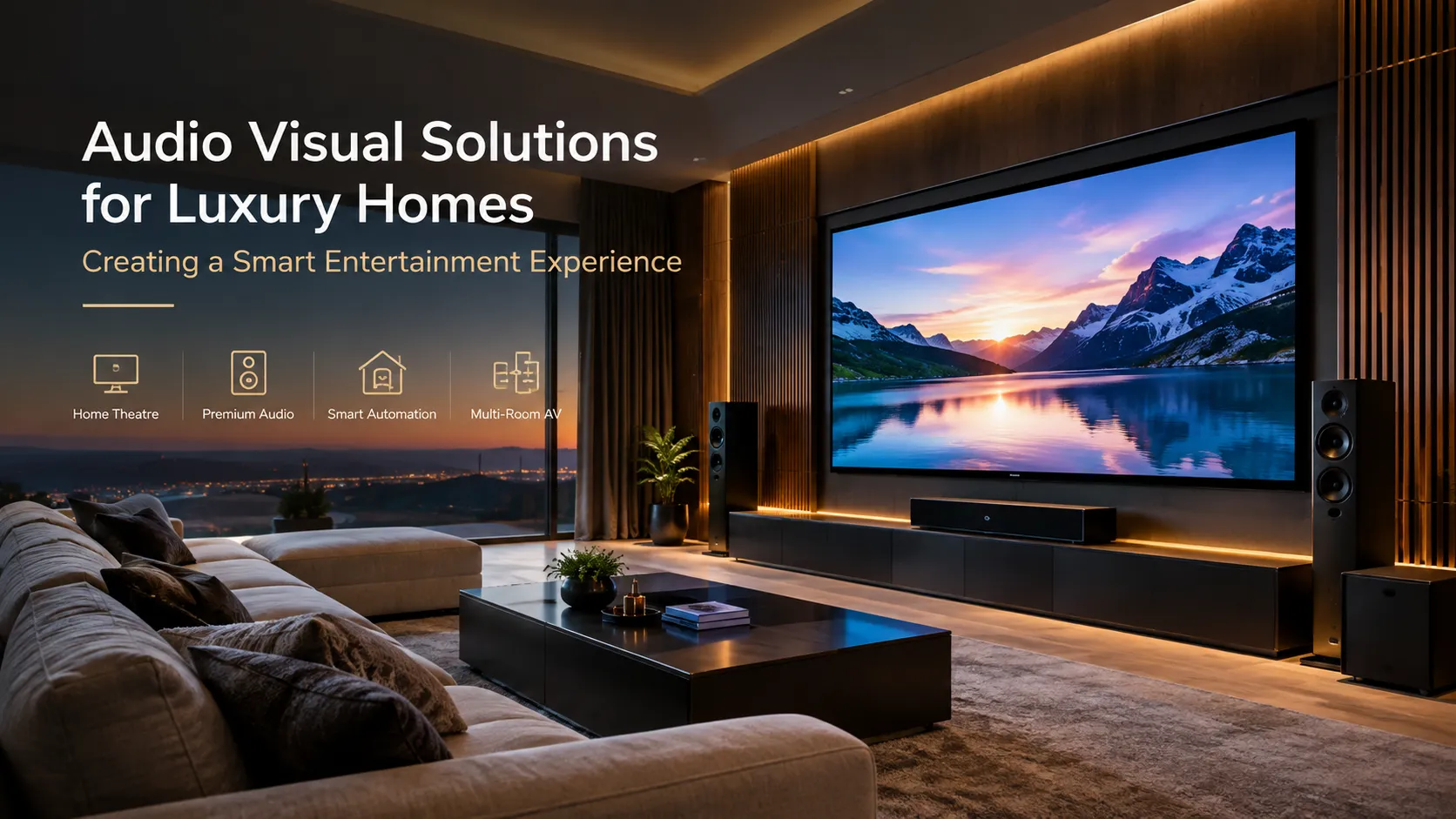
Audio Visual Solutions for Luxury Homes: Creating a Smart Entertainment Experience
Luxury homes are increasingly designed around experiences, not just appearances. A beautifully designed living room, dedicated cinema, or entertainment area can become even more functional when audio, video, lighting, and automation are planned as part of the space from the beginning.
Modern audio visual solutions can bring together home theatres, high-performance audio, premium displays, multi-room entertainment, lighting, motorized curtains, and smart-home controls. But creating a high-quality system is not simply a matter of purchasing expensive speakers or a large television.
The right solution needs to consider the room, acoustics, interior design, lifestyle, technology, and future requirements together. For homeowners building or renovating a luxury residence, this approach can create an entertainment system that feels integrated into the home rather than added to it.
In this guide, Sound Innovators — a luxury AV consultancy with 18+ years of experience, headquartered in Mumbai with a regional office in Pune — explains what audio visual solutions include, how custom systems differ from standard setups, and how to plan one step by step.
- What Are Audio Visual Solutions for Luxury Homes?
- Custom AV vs Standard Entertainment Systems
- Key Elements of a Luxury Home AV System
- Why AV Planning Should Start Before Interior Work
- How to Plan Custom Audio Visual Solutions
- The Role of Luxury Home Theatre Consultation
- Integrating AV With Smart Home Automation
- Custom AV vs Off-the-Shelf: Which Is Right?
- How to Future-Proof a Luxury AV System
- What Makes a Luxury AV Experience Successful?
- Final Thoughts
- Frequently Asked Questions
What Are Audio Visual Solutions for Luxury Homes?
Audio visual solutions are integrated systems that combine audio and video equipment with the infrastructure and controls required to deliver entertainment throughout a home. Depending on the property and the homeowner’s requirements, a system may include:
Home Theatre
Dedicated custom design home theatre systems, projectors or large-format displays, motorized projection screens, wireless surround sound and Dolby Atmos.
Audio
High-end High Fidelity (HiFi) stereo system, in-wall and in-ceiling speakers, multi-room audio with architectural speakers, outdoor audio system.
Smart Integration
Motorized curtains and blinds, smart lighting integration, centralized AV control, home automation, outdoor entertainment systems.
Behind the Scenes
Acoustic treatment and concealed wiring and equipment.
The important difference is that these components can be planned to work together. For example, a homeowner could create a movie scene that dims the lights, closes the curtains, lowers the screen, turns on the projector, and activates the audio system with a single command.
That is where a professionally planned AV system becomes more than a collection of entertainment devices.
Why Custom AV Solutions Are Different From Standard Entertainment Systems
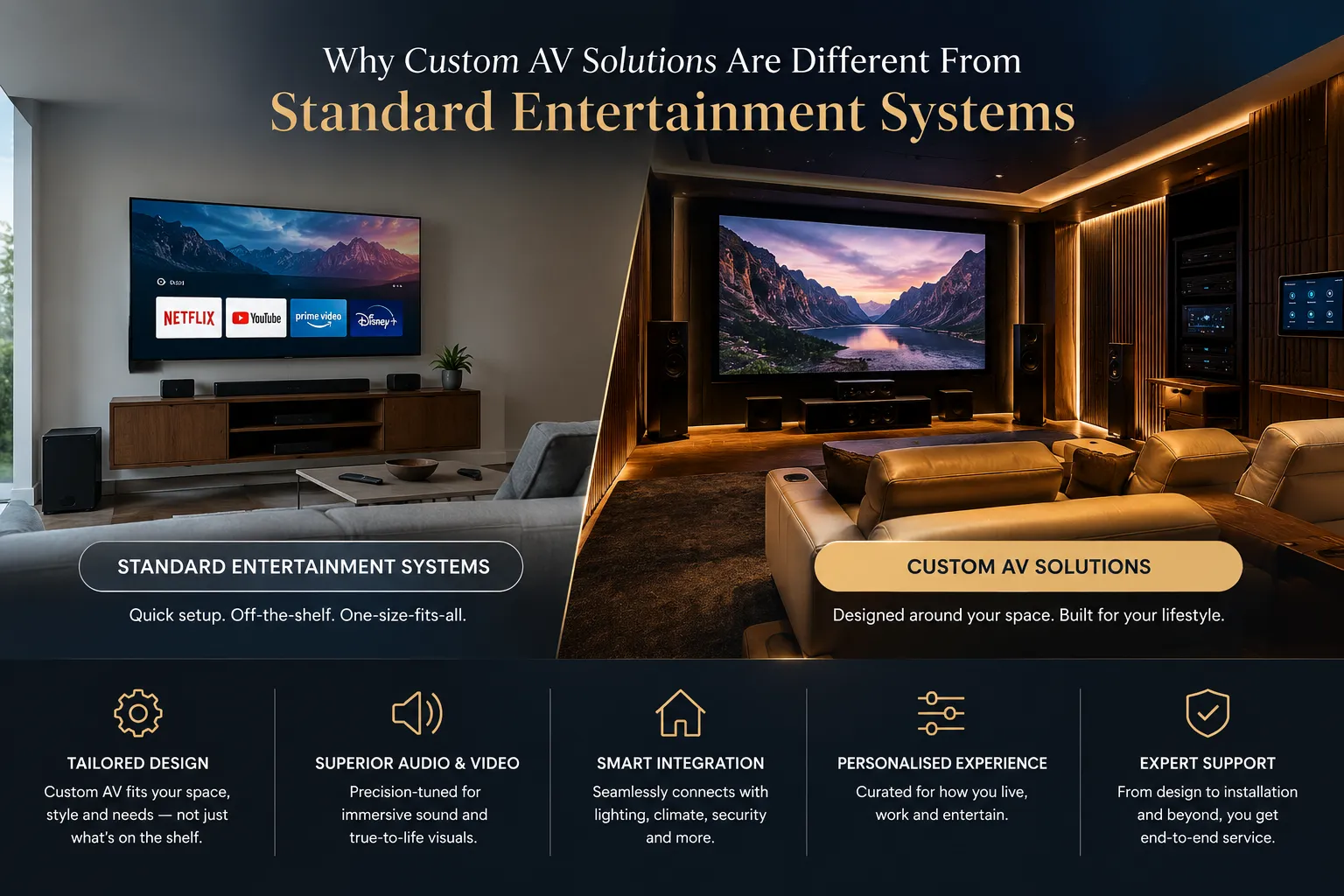
Custom AV solutions compared with standard entertainment systems (Sound Innovators, 2026)
A standard entertainment setup generally starts with the equipment. A custom system starts with the experience and the space.
A television may work well in one room but not another. Similarly, speaker placement, projector position, screen size, viewing distance, and acoustics can significantly influence the final experience. A custom approach considers these factors before equipment is selected.
| Standard AV Setup | Custom AV Solution |
|---|---|
| Basic equipment selection | Room-specific design |
| Separate controls | Centralized control |
| Visible equipment | Concealed integration where appropriate |
| Limited planning | Architectural and interior planning |
| Basic acoustic consideration | Acoustic optimization |
| Limited expansion | Future-ready infrastructure |
← Scroll table on mobile →
This does not mean every home requires a complex custom installation. A simple entertainment requirement may be adequately served by an off-the-shelf system. Custom audio visual solutions become particularly valuable when the homeowner wants multiple rooms, dedicated cinema spaces, concealed technology, advanced audio, automation, or a system designed around a premium interior.
Key Elements of a Luxury Home AV System
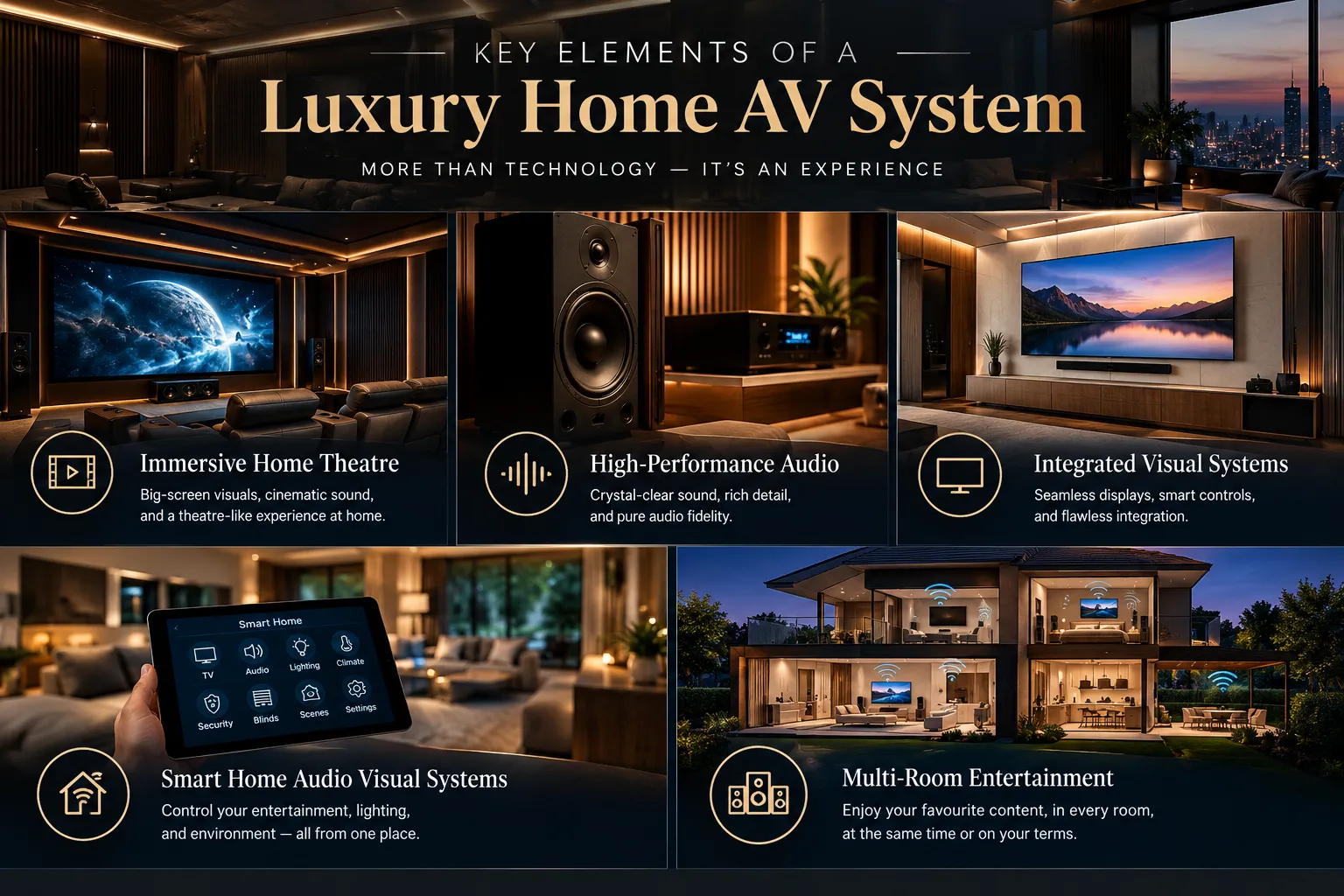
Key elements of a luxury home AV system (Sound Innovators, 2026)
Immersive Home Theatre
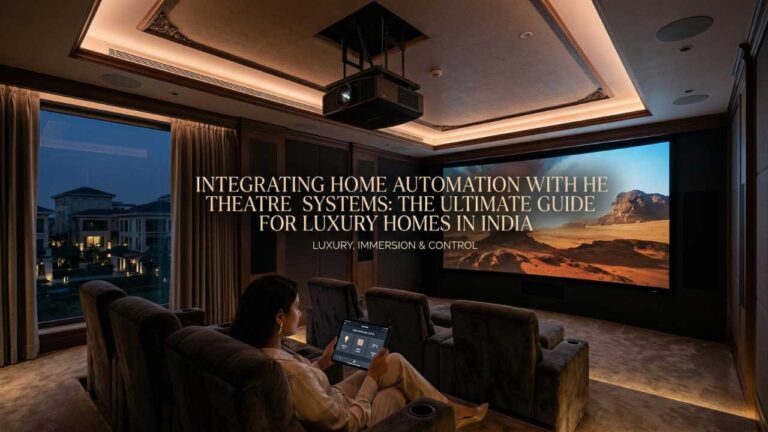
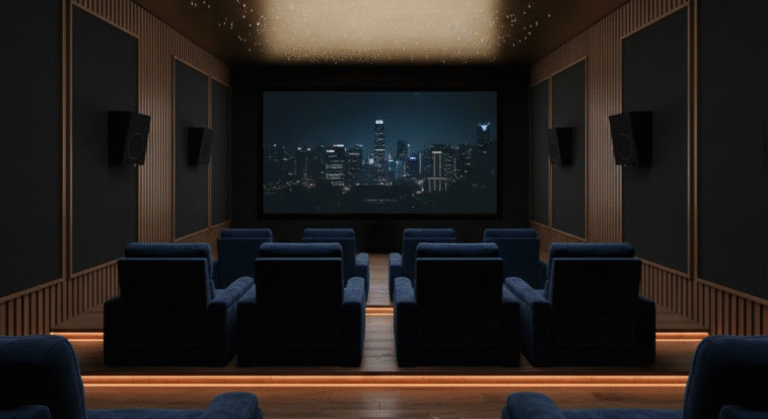
A dedicated home theatre can provide a more controlled entertainment environment than a conventional living-room setup. The system may combine a projector and large screen with surround sound, subwoofers, acoustic treatment, dedicated seating, controlled lighting, and automation.
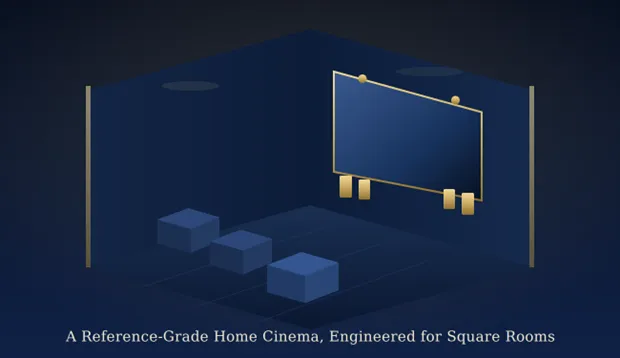
Screen size needs to work with viewing distance. Speaker locations should be planned around seating positions. Acoustic treatment needs to complement the room. Projector placement and wiring should also be considered before construction is complete. This is why professional planning can be particularly useful for a dedicated cinema room.
High-Fidelity (HiFi) Stereo System
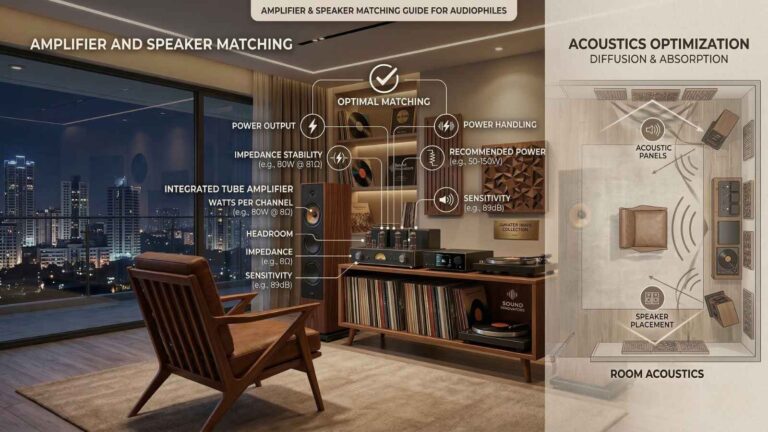
For homeowners who appreciate detailed, natural and immersive music reproduction, a High-Fidelity (HiFi) stereo system can become an important part of the luxury entertainment experience. A well-designed HiFi setup may include:
- High-end stereo speakers — floorstanding or bookshelf
- Dedicated stereo amplifiers like stereo pre-amplifiers, power amplifiers or monoblocks
- Network or digital music streamers or SACD player
- High-quality DACs and source components
- Turntables and vinyl playback systems
- Subwoofers for deeper and more controlled bass
The right combination depends on the room size, acoustics, listening position, interior design and the homeowner’s listening preferences. A premium HiFi system is not simply about choosing the most expensive components. Speaker positioning, amplifier matching, room acoustics, source quality and system calibration all contribute to the final listening experience.
Integrated Visual Systems
Different rooms may require different display technologies. A dedicated cinema uses a projector and screen, while a living room might benefit from a large premium display. Other possibilities can include:
4K & 8K Displays
Large premium displays for living and media rooms.
Laser Projectors
For dedicated cinema rooms, paired with motorized projection screens.
Cinemascope Screen Format
A wide-format option for dedicated cinema spaces.
Mirror TV & Large-Format Displays
Displays that blend into the interior.
Outdoor Entertainment Displays
For terraces, poolside and garden areas.
The objective should be to select technology according to the room and intended use rather than installing identical equipment throughout the property.
Smart Home Audio Visual Systems
Modern smart home audio visual systems can connect entertainment with other functions within the residence, including lighting, motorized curtains, screens, climate controls, multi-room audio, and home automation scenes. Consider a “Movie Night” scene. With one command, the system could:
The goal is not simply automation for its own sake. It is to make the technology easier and more natural to use.
Multi-Room Entertainment
Luxury homes often contain several areas where entertainment can be enjoyed. A properly planned multi-room system can allow different zones to operate independently while still being managed from a centralized interface.
| Zone | Typical Entertainment |
|---|---|
| Living room | TV and surround sound or HiFi system |
| Dining area | Background music |
| Bedroom | Personal entertainment |
| Pool area | Outdoor audio |
| Home theatre | Dedicated cinema system |
← Scroll table on mobile →
This type of setup can be part of a broader whole home audio video smart home automation system, depending on the home’s requirements and selected technology.
Concealed Technology and Interior Integration
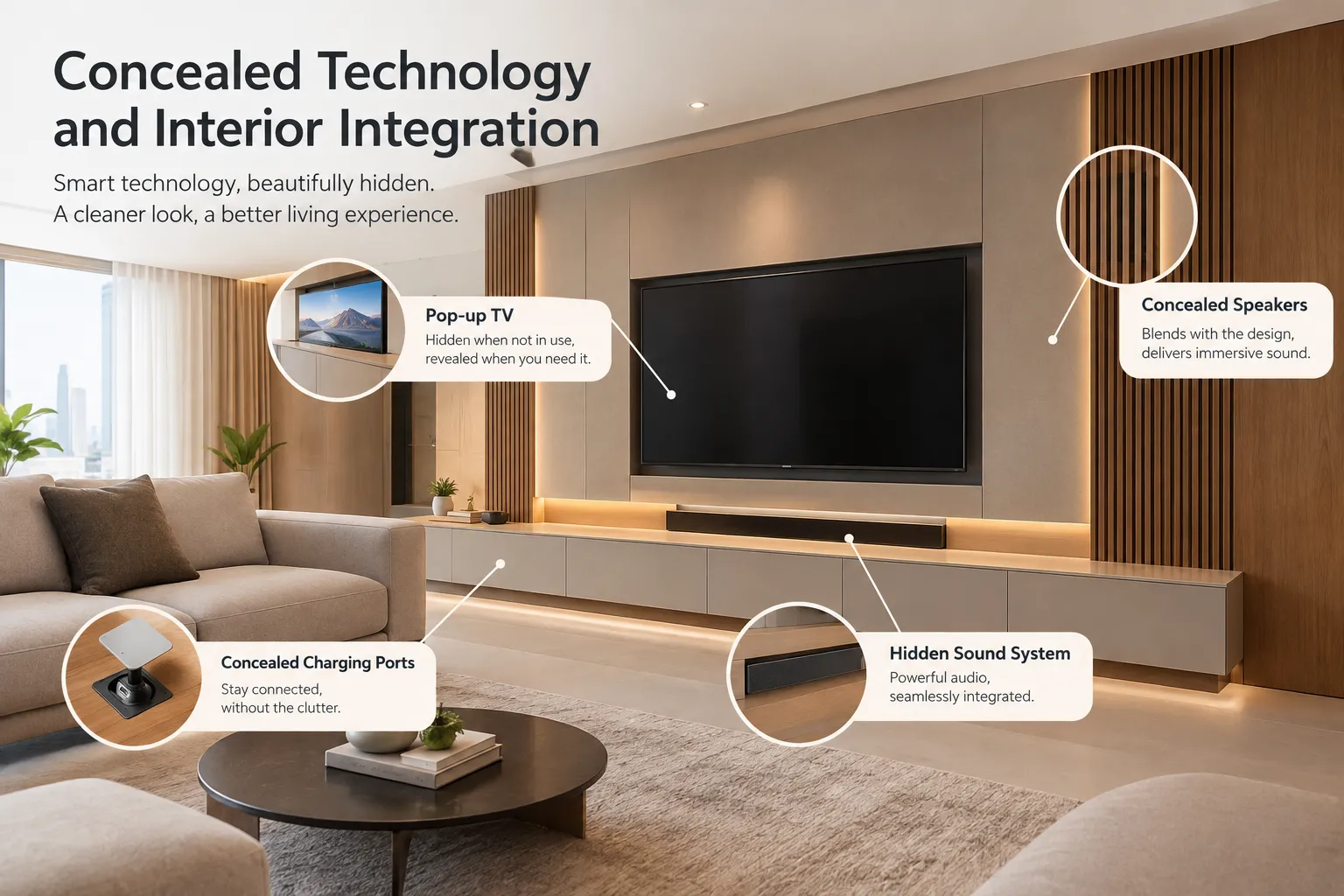
Concealed technology and interior integration (Sound Innovators, 2026)
Technology does not always need to become the visual focus of a luxury interior. Where appropriate, AV equipment can be integrated using in-wall speakers, in-ceiling speakers, concealed wiring, hidden equipment racks, motorized displays, flush-mounted screens, acoustic panels, and custom cabinetry.
This is particularly useful when homeowners want premium technology without allowing cables, equipment, and speakers to dominate the interior. Luxury AV is therefore not only about performance. It is also about how well technology fits into the overall design.
Centralized Control and Automation
As the number of devices increases, controlling each component separately can become inconvenient. A centralized control system can bring different components together through a single interface or predefined scenes. Instead of separately operating the projector, receiver, lights, screen, and curtains, the homeowner could activate a predefined entertainment scene.
This type of audio visual automation can make a complex system easier for homeowners, family members, and guests to operate.
Why AV Planning Should Start Before Interior Work
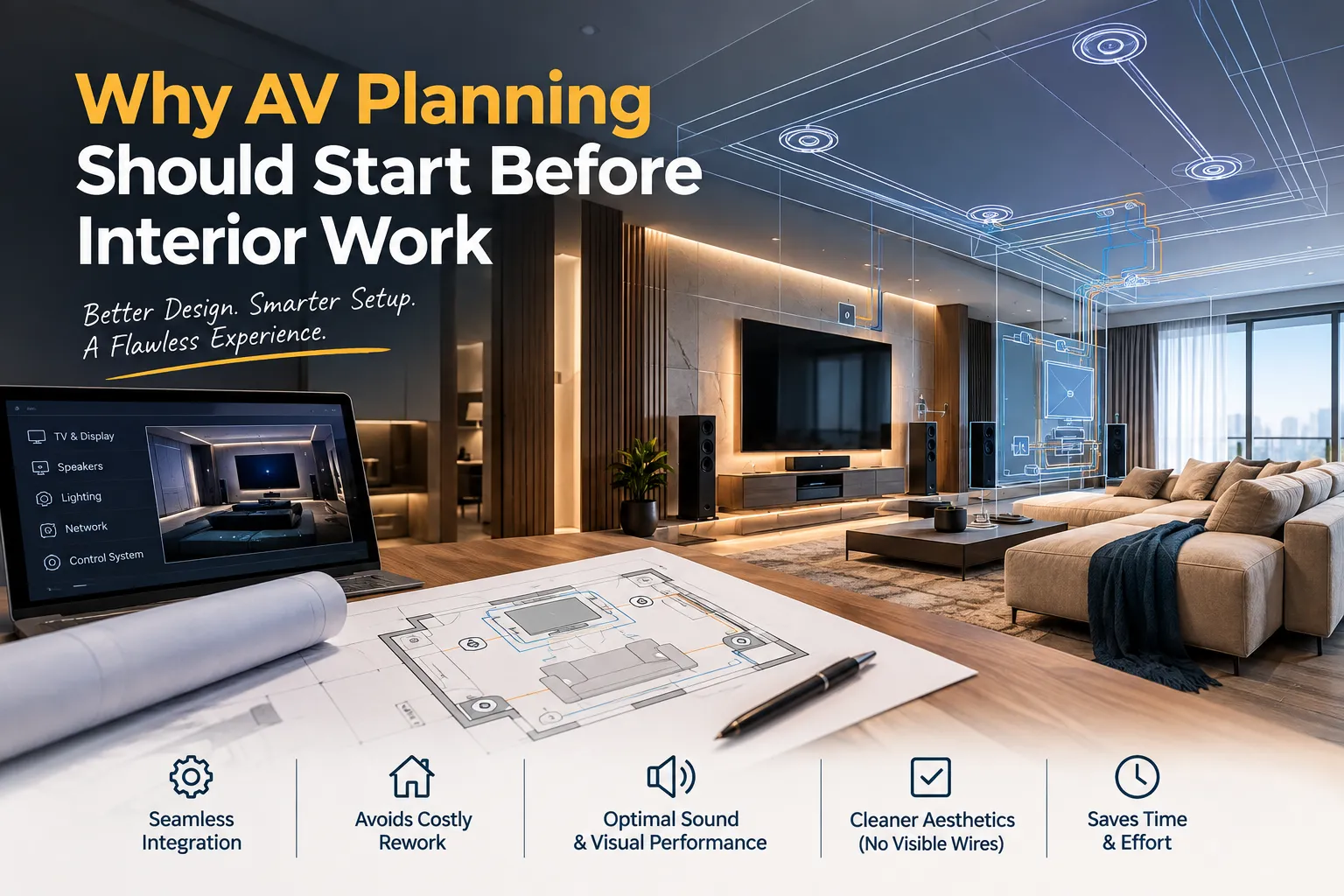
Why AV planning should start before interior work (Sound Innovators, 2026)
One of the most important considerations for a luxury AV project is timing. Waiting until the interior work is nearly finished can create unnecessary limitations. For example:
- Speaker locations may conflict with lighting or furniture.
- Projector placement may not provide the required throw distance.
- The screen may not be appropriate for the seating position.
- Acoustic treatment may conflict with the interior design.
- Equipment may have no suitable location.
- Running cables after walls are finished can become difficult.
- Power and networking requirements may not have been considered.
Early planning allows the AV requirements to be coordinated with architecture, electrical work, interior design, lighting, furniture, networking, and automation.
This is particularly important for new luxury homes, where decisions made during the design stage can have a significant impact on the final AV installation.
How to Plan Custom Audio Visual Solutions
A successful project should begin with planning rather than equipment shopping. Follow these six steps in order:
-
Understand the Homeowner’s Lifestyle
First, determine how the homeowner intends to use the system. The priorities might include movies, sports, music, gaming, family entertainment, hosting guests, and outdoor entertainment. The answers help determine what type of system is appropriate.
-
Assess the Room
The physical space should then be evaluated. Important considerations include:
- Room dimensions, ceiling height and room shape
- Natural and artificial light
- Seating position and viewing distance
- Loss over speaker cable distance
- Bass management
- Acoustic characteristics and interior design
-
Plan Audio and Video
Once the room is understood, the audio and visual components can be selected. This may include displays, projectors, screens, speakers, amplifiers, receivers, subwoofers, and control systems. The components should be selected as a system rather than as unrelated products.
-
Plan Automation
The next stage is determining which functions should work together — AV, lighting, curtains, screens, climate, and multi-room audio. Not every function needs to be automated. Automation should be based on convenience and the homeowner’s actual requirements.
-
Plan Wiring and Infrastructure
Infrastructure is easy to overlook because it is not visible after installation. However, appropriate cabling, networking, power, equipment locations, and cable pathways are essential for a reliable system. Future requirements should also be considered at this stage.
-
Installation and Calibration
After installation, the system should be tested and calibrated. This may include checking speaker performance, audio levels, display settings, projector alignment, control scenes, network connectivity, and automation functions. Proper calibration helps ensure that the installed equipment performs as intended within the actual room.
The Role of Luxury Home Theatre Consultation
A Luxury Home Theatre Consultation can help homeowners make important decisions before equipment is purchased or construction is completed. A consultation can consider:
The Room
Room dimensions, seating arrangement, viewing distance, lighting.
Picture
Screen size and projector placement.
Sound
Speaker positioning and acoustic requirements.
Infrastructure
Wiring, equipment placement and automation.
This early-stage planning is particularly useful when the theatre is being designed alongside the home’s architecture or interior. Rather than choosing equipment first and trying to make it fit later, consultation allows the room and technology to be considered together.
Integrating AV With Smart Home Automation
The role of AV is becoming increasingly connected to wider residential automation. A homeowner may want entertainment, lighting, curtains, and other functions to respond together rather than operate as completely separate systems.
Movie Mode
Lights dim → curtains close → screen lowers → projector starts → AV system activates.
Music Mode
Selected music starts → preferred lighting scene activates → audio plays in the chosen rooms.
This type of audio visual home automation can make everyday use more convenient. For homeowners evaluating the best smart home automation systems, compatibility with AV equipment is an important consideration. The automation platform should work with the devices and functions the homeowner actually intends to use.
Custom AV vs Off-the-Shelf Systems: Which Is Right?
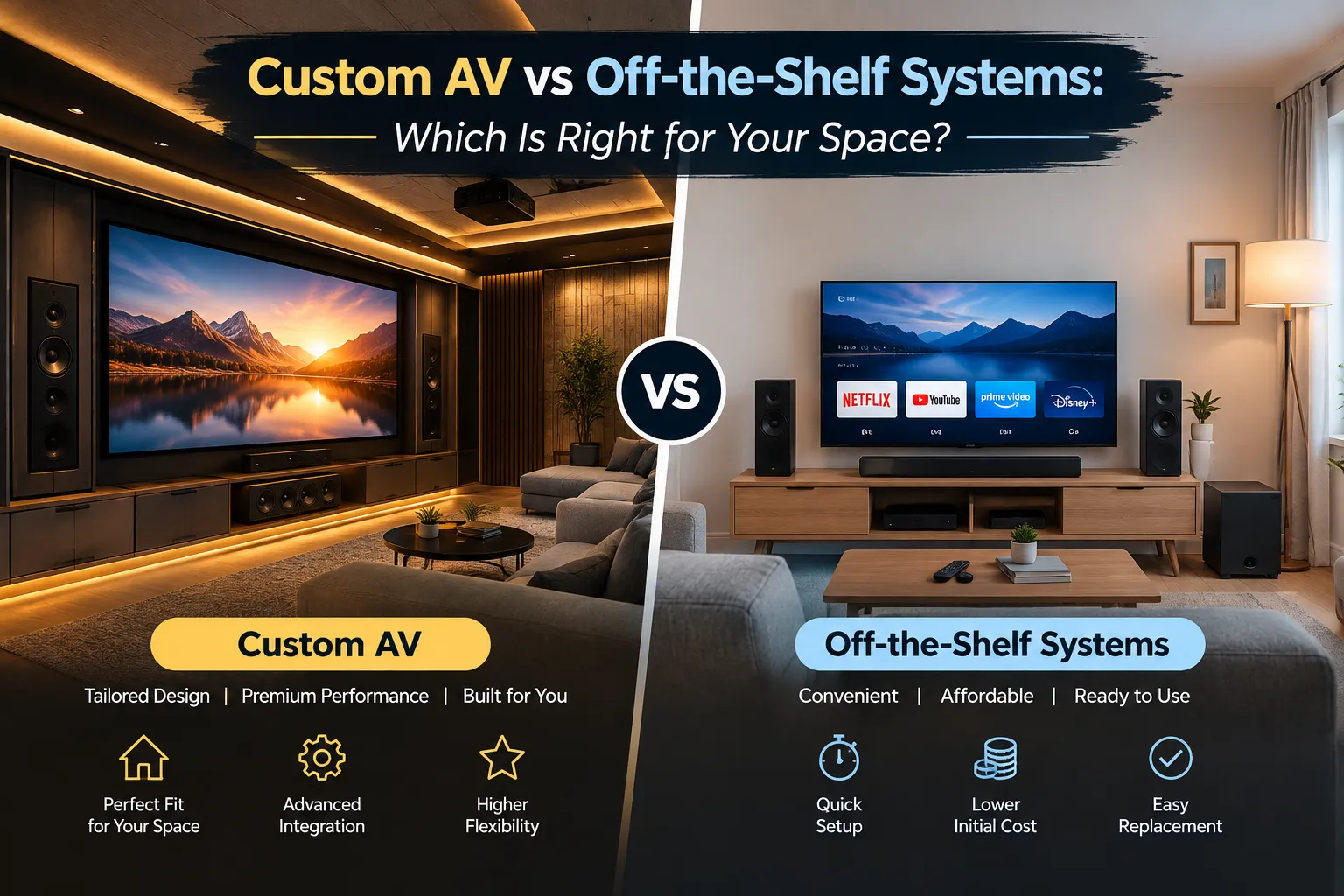
Custom AV vs off-the-shelf home entertainment systems (Sound Innovators, 2026)
Not every homeowner needs a fully customized installation.
Simple Requirements
Makes sense when the requirement is relatively simple, such as a television and soundbar in one room.
Complex Projects
More useful with multiple entertainment zones, a dedicated home theatre, high-performance audio, concealed technology, centralized control, smart-home integration, complex wiring, acoustic treatment, or future expansion.
The best approach is therefore not automatically the most complicated system. It is the system that matches the home’s requirements without unnecessary complexity.
How to Future-Proof a Luxury AV System
Technology changes quickly, so a luxury AV installation should be planned with future upgrades in mind. Some considerations include:
Scalable Wiring
Provide suitable infrastructure so additional equipment can be accommodated later.
Network Infrastructure
Modern AV and smart-home systems can depend heavily on reliable networking, so plan it alongside the AV installation.
Accessible Equipment
Install equipment where it can be reached for maintenance or replacement.
Spare Cable Pathways
Additional pathways make future upgrades easier without major changes to finished interiors.
Expandable Automation
The automation system should ideally have room for additional compatible devices or functions.
Upgrade-Friendly Design
Individual components can be replaced or upgraded without redesigning the entire system.
What Makes a Luxury AV Experience Truly Successful?
A luxury AV system should not be judged only by the price of its equipment. A successful system balances:
The audio should suit the room. The display should suit the viewing environment. The controls should be simple. Equipment should be appropriately integrated into the interior. Most importantly, the system should serve the homeowner’s lifestyle.
The best AV installation is therefore not necessarily the one with the largest number of devices. It is the one where technology works together naturally and is easy to use.
Final Thoughts
Modern audio visual solutions can transform how luxury homes are experienced by bringing entertainment, technology, and design together. A dedicated luxury home theatre, multi-room audio system, premium display, concealed speakers, automated lighting, and centralized control can all become part of a carefully planned residential technology ecosystem.
However, the foundation of a successful system is planning. Understanding the homeowner’s lifestyle, assessing the room, considering acoustics and interior design, planning infrastructure, integrating automation, and allowing for future upgrades can produce a more practical and enjoyable result than simply purchasing high-end equipment.
For homeowners building or renovating a luxury residence, considering AV during the planning stage can make it easier to create an entertainment environment that feels like a natural part of the home.
Frequently Asked Questions: Audio Visual Solutions for Luxury Homes
What are audio visual solutions for a luxury home?
Audio visual solutions combine audio, video, control, and related technologies to create an integrated entertainment experience. Depending on the property, this can include home theatres, projectors, displays, speakers, multi-room audio, centralized controls, lighting integration, and home automation.
What is included in a custom AV system?
A custom AV system can include displays or projectors, speakers, amplifiers, receivers, subwoofers, screens, control systems, wiring, networking, acoustic treatment, and automation. The exact components depend on the rooms, intended usage, interior design, and homeowner’s requirements.
Why should AV planning happen before interior design?
Early AV planning helps coordinate speaker locations, display placement, projector position, wiring, acoustic treatment, equipment storage, lighting, and furniture with the interior design. Planning later can limit equipment placement or require additional work to finished walls and ceilings.
What is included in a luxury home theatre consultation?
A consultation can review room dimensions, seating, viewing distance, screen size, projector placement, speaker positioning, acoustics, lighting, wiring, equipment locations, and automation requirements. The purpose is to establish a suitable design before equipment and installation decisions are finalized.
Can AV systems be integrated with smart home automation?
Yes. Compatible AV systems can be integrated with functions such as lighting, motorized curtains, screens, climate controls, and multi-room audio. This can allow homeowners to operate several functions through a centralized interface or predefined scenes.
What is the difference between standard and custom AV systems?
A standard AV setup generally uses readily available equipment with limited integration. A custom system is designed around the room and homeowner’s requirements and may include concealed technology, acoustic planning, centralized control, automation, and infrastructure for future expansion.
How can a luxury AV system be future-proofed?
Future-proofing can involve scalable wiring, reliable network infrastructure, accessible equipment locations, spare cable pathways, expandable automation, and upgrade-friendly system design. These measures can make it easier to add or replace technology later.
Planning Your Luxury AV System? Let’s Build It Together.
Sound Innovators has 18+ years of experience designing India’s finest luxury home theatres and automation systems. We craft every system around your vision, your room, and your home.
📞 Book a Free ConsultationExplore Home Theatre Services
Mumbai & Pune, India | By Appointment Only | soundinnovators.in