Dolby Atmos Home Cinemas in India: Design, Calibration and Cost Explained
Dolby Atmos home cinemas in India are no longer limited to villa basements. Apartments in Mumbai, Pune and Bengaluru now host serious Atmos rooms, yet many buyers still end up with a boxed speaker package that never reaches cinema quality. This guide explains the Dolby Atmos home theatre setup India homeowners actually need: layouts, room realities, calibration, signal chain and cost.
- 01What Makes a Dolby Atmos Home Cinema Different from a TV or Soundbar?
- 02Which Dolby Atmos Speaker Layout Suits Your Room: 5.1.2 or 7.1.4?
- 03What Indian Room Conditions Affect Dolby Atmos Home Cinemas?
- 04Why Do Acoustics and Calibration Matter More Than Speaker Count?
- 05What Does a Dolby Atmos Home Theatre Setup in India Need for Signal and Content?
- 06How Much Does a Dolby Atmos Home Theatre Cost in India?
- 07Plan Your Dolby Atmos Home Cinema
- 08Frequently Asked Questions
What Makes a Dolby Atmos Home Cinema Different from a TV or Soundbar?
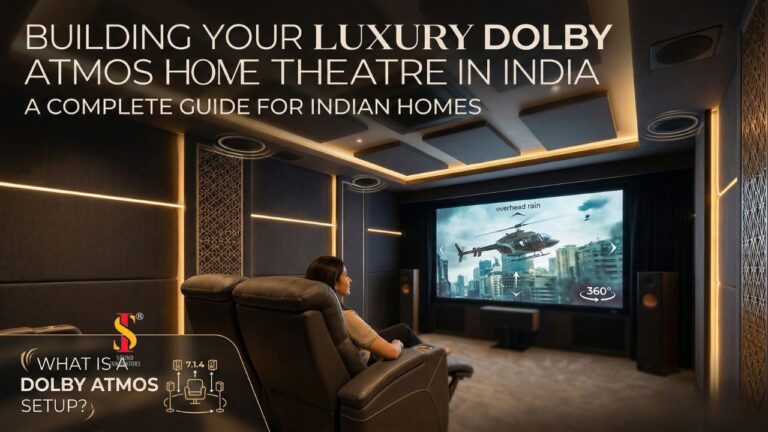
Dolby Atmos is an object-based format that places sounds in three-dimensional space, including overhead, instead of sending them to fixed channels. A true Atmos home cinema uses separate speakers, including height speakers, driven by an AV receiver or processor. A TV or soundbar can decode Atmos, but built-in speakers can only simulate height, so placement is far less precise.
The notation tells you the layout. In 7.1.4, seven speakers sit at ear level, one (or more as per room requirements) subwoofer handles bass and four speakers are overhead. Our home theatre design service starts by matching that layout to your room.
Which Dolby Atmos Speaker Layout Suits Your Room: 5.1.2 or 7.1.4?
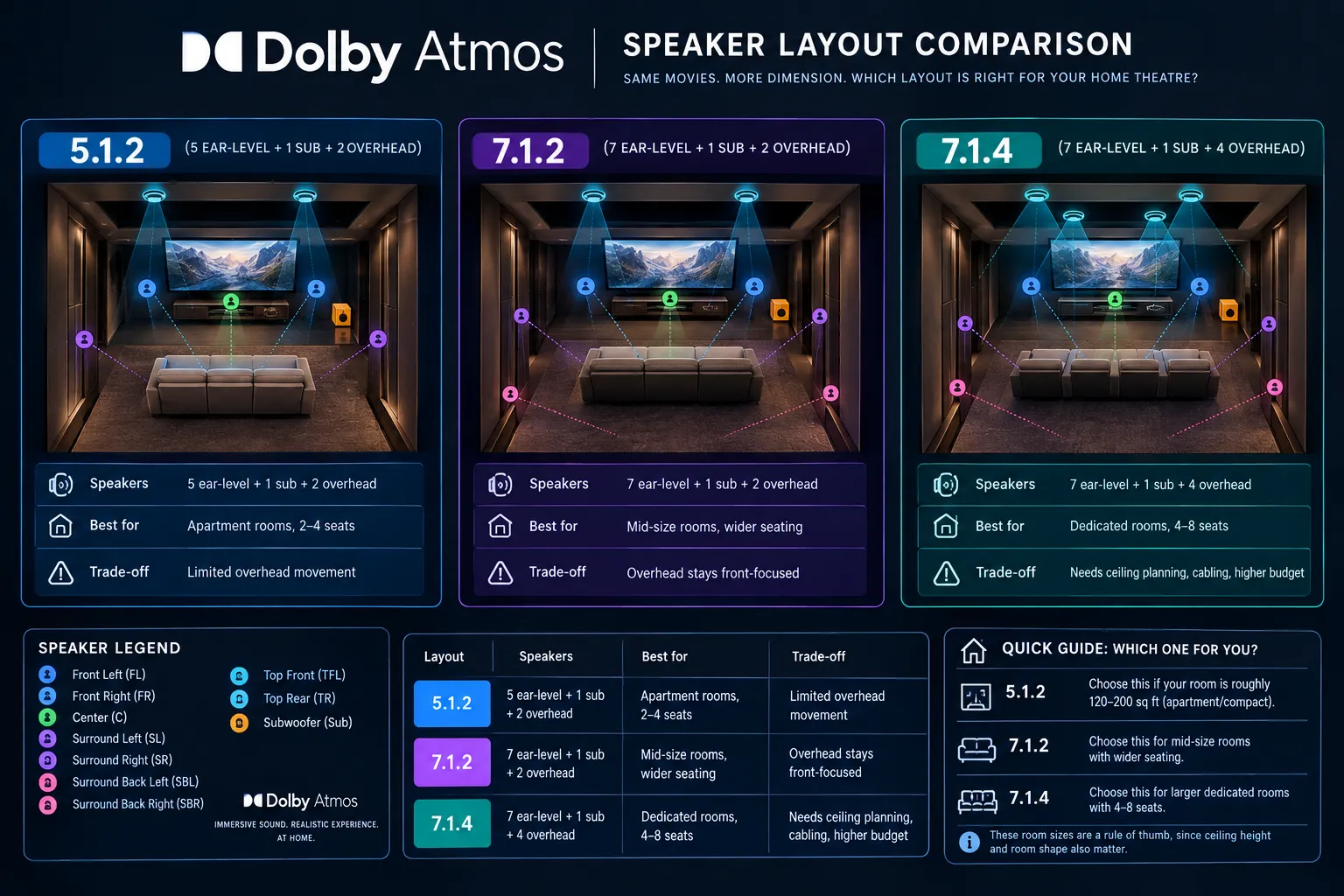
Choose 5.1.2 for rooms of roughly 120–200 sq ft and 7.1.4 for larger dedicated rooms. Treat these sizes as a rule of thumb, since ceiling height and room shape also matter.
| Layout | Speakers | Best for | Trade-off |
|---|---|---|---|
| 5.1.2 | 5 ear-level, 1 sub, 2 overhead | Apartment rooms, 2–4 seats | Limited overhead movement |
| 7.1.2 | 7 ear-level, 1 sub, 2 overhead | Mid-size rooms, wider seating | Overhead stays front-focused |
| 7.1.4 | 7 ear-level, 1 sub, 4 overhead | Dedicated rooms, 4–8 seats | Needs ceiling planning, cabling, higher budget |
← Scroll table on mobile →
Some guides claim Atmos isn’t worth it in smaller rooms. A well-planned 5.1.2 still delivers the overhead cue that makes rain and helicopters convincing, provided the speakers are placed and calibrated correctly. Overhead speakers should sit above or slightly ahead of the main seat. In 7.1.4, the rear pair covers the back rows. Up-firing Atmos modules need flat, reflective ceilings of roughly 8–14 ft, while in-ceiling speakers suit false-ceiling builds.
What Indian Room Conditions Affect Dolby Atmos Home Cinemas?
Indian homes create problems that overseas guides rarely cover:
Ceiling height and false ceilings: Many apartments offer 9–10 ft from slab to ceiling. Overhead speakers and ducting must be planned before the false ceiling closes.
Structure-borne bass: RCC slabs carry low frequencies to neighbours. Speaker placement and decoupling matter more than simply thicker walls.
AC and ventilation noise: Split-AC and duct noise raise the noise floor and mask fine detail.
Humidity and monsoon: Cabling, fabric panels and electronics need moisture-safe materials and airflow.
Power quality: Voltage fluctuation stresses processors and amplifiers, so surge protection and conditioning are worth including.
The cheapest time to plan a cinema is during interior design, not after. Our AV integration for builders and interior designers coordinates ceiling loads, conduit routes and equipment ventilation with your civil and interior teams.
Why Do Acoustics and Calibration Matter More Than Speaker Count?
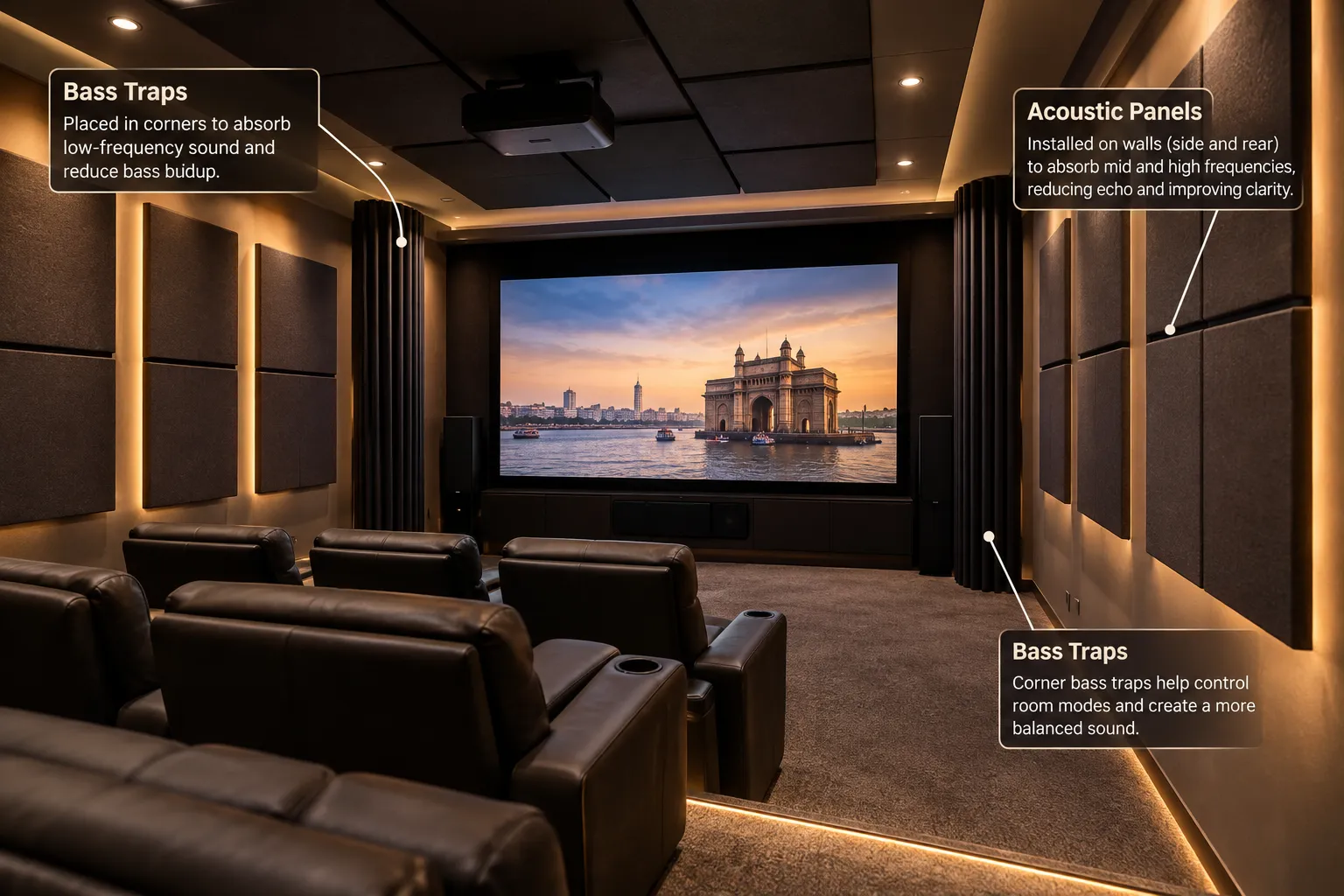
The room shapes what reaches your ears, so the same speakers can sound very different in two rooms. Home theatre room acoustics and calibration in India decide whether dialogue stays clear and bass stays even across every seat.
Acoustic treatment tackles the room itself: bass traps in corners, absorption at first reflection points and diffusion where needed. A home cinema typically aims for reverberation well under half a second. Calibration then measures each speaker from the seating position and corrects level, delay, distance and frequency response using room-correction tools such as Dirac Live or Trinnov Optimizer, depending on the processor.
Most Indian guides stop at equipment lists. Calibration is where installer expertise shows: measurement, correction and listening tests rather than plugging in speakers. It is a core part of our home theatre installation and calibration.
What Does a Dolby Atmos Home Theatre Setup in India Need for Signal and Content?
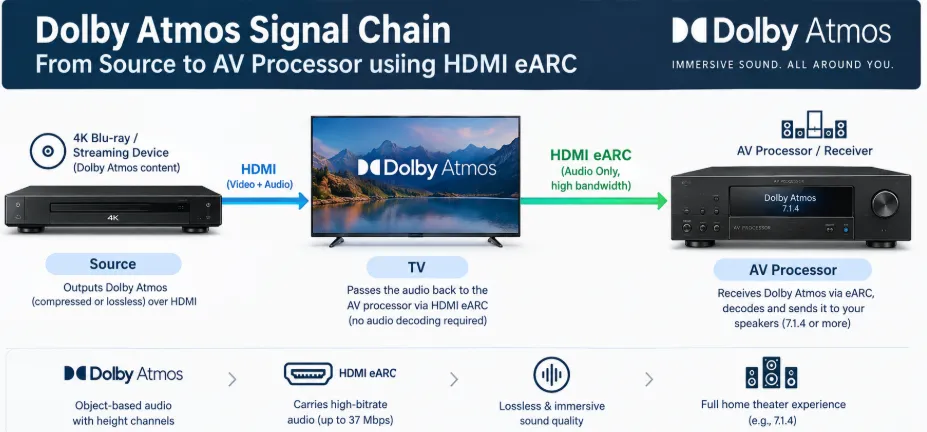
Atmos needs an Atmos-capable source, a compatible HDMI path and an AV processor with enough channels. Streaming apps deliver Atmos over Dolby Digital Plus, while Blu-ray and Kaleidescape use lossless Dolby TrueHD. Connect players directly to the processor. Use HDMI eARC for TV-based apps, since ARC cannot carry lossless TrueHD Atmos.
Check channel count too. A 7.1.4 layout needs eleven amplified channels plus a subwoofer output. An Atmos logo on a television doesn’t make a cinema.
How Much Does a Dolby Atmos Home Theatre Cost in India?
Dolby Atmos home theatre cost in India depends on layout, room work and brands. Indicative ranges:
5.1.2 in a living room: ₹10,00,000 lakh+
7.1.4 in a dedicated, treated room: ₹ 50,00,000 lakh+
As a planning guide, speakers and amplification take the largest share, followed by the display or projector, then acoustics and build work. Reserve budget for calibration and cabling to avoid expensive rework later. Ask for a project-specific estimate after a room survey.
Plan Your Dolby Atmos Home Cinema
Planning Dolby Atmos home cinemas in India for a new home or renovation? Talk to Sound Innovators for a room survey, layout plan and calibration.