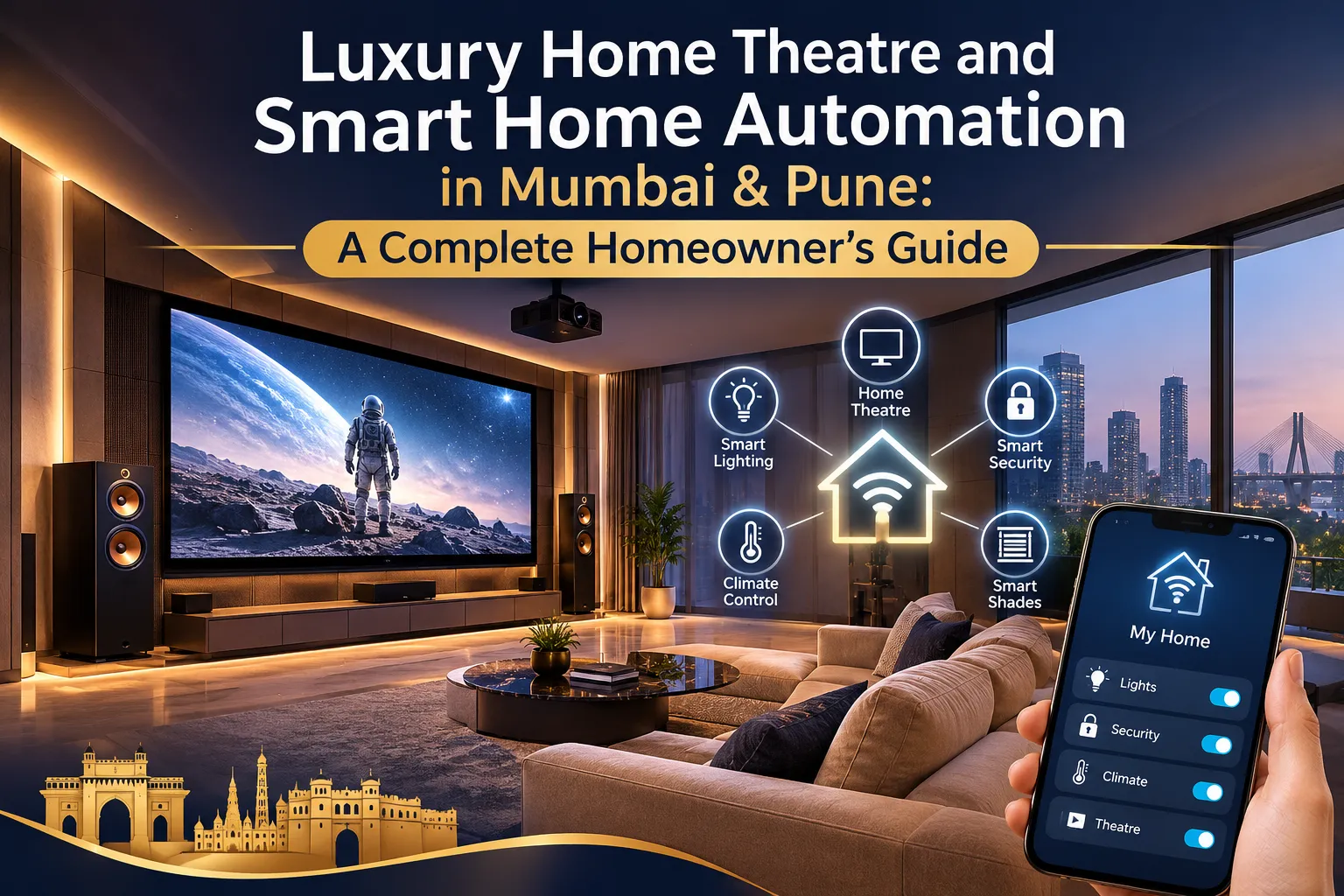
Luxury Home Theatre and Smart Home Automation in Mumbai & Pune: A Complete Homeowner’s Guide
You have chosen the stone, the joinery and the lighting. Now the family wants a proper cinema, music in every room and a home that responds to a single touch. These wishes compete with the architecture. Speakers need space, projectors need throw distance and equipment needs air.
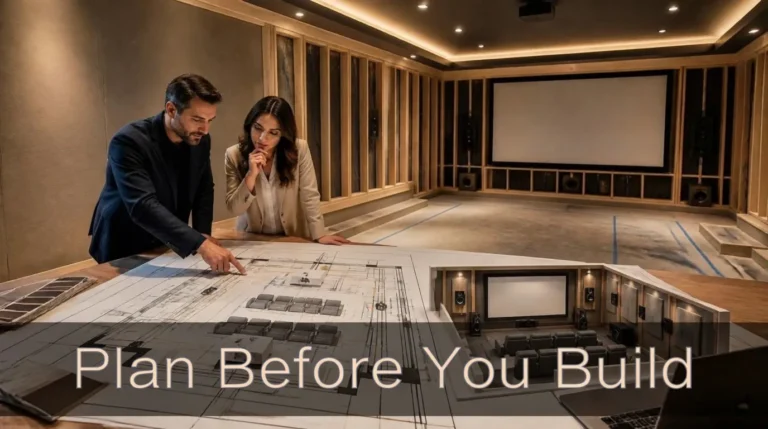
Buying premium equipment does not solve this on its own. A room finished without acoustic planning, cable routes or ventilation will limit even the finest components. A successful luxury AV experience depends on how the room, the technology and the interior design are planned together.
This guide is for homeowners in Mumbai and Pune who are building, renovating or upgrading a premium residence. It explains how a private cinema, high-performance audio and automation work as one coordinated environment, and what to decide before the walls close.
- Why Luxury Homes Need a Different Approach to AV Planning
- Luxury Home Theatre Consultation: What Should Be Planned First?
- Best Smart Home Automation Systems for Luxury Residences
- Home Theatre Design and Installation Services: From Concept to Commissioning
- Planning a Dolby Atmos Home Cinema Setup
- High-End Hi-Fi Audio: Creating a Dedicated Listening Experience
- Integrating Home Theatre, Music, Lighting and Automation
- Mumbai vs Pune: What Should Luxury Homeowners Consider?
- How to Choose a Luxury Residential AV Consultant
- Common Planning Mistakes to Avoid
- Frequently Asked Questions
Why Luxury Homes Need a Different Approach to AV Planning
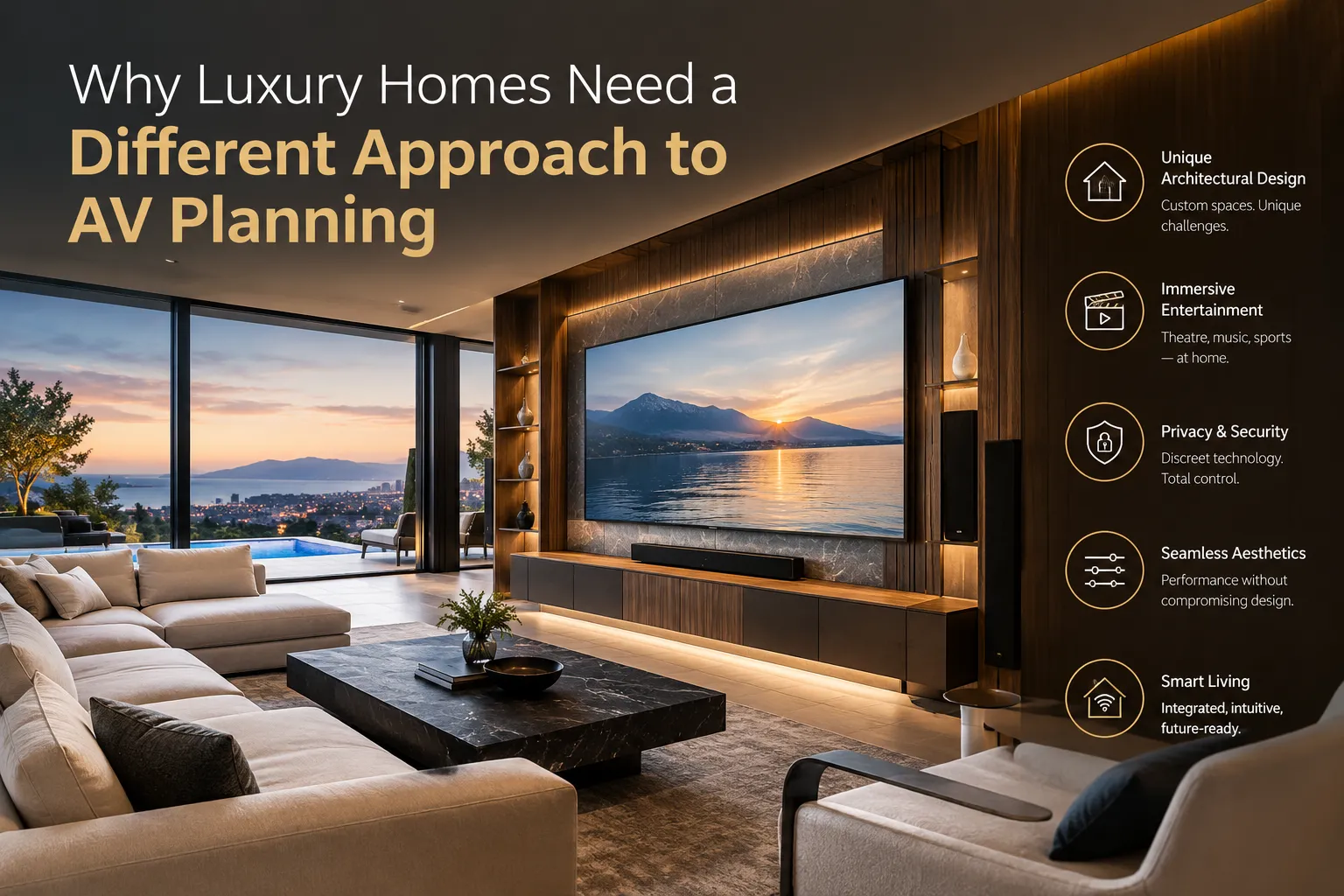
A luxury home needs a designed AV environment, not a shopping list of devices. Design treats acoustics, power, cabling, control and aesthetics as one brief. Individually purchased products usually arrive with separate remotes, separate apps and no shared logic.
A coordinated approach changes daily life. One interface starts a film, adjusts the lighting and closes the curtains. Equipment stays hidden but ventilated. Cables are routed before finishes are fixed, so nothing is chased into a completed wall.
Priorities also differ by property type:
| Property type | Typical planning priorities |
|---|---|
| Penthouse | Large glazing and light control, neighbour noise, terrace entertaining |
| Luxury apartment | Limited ceiling void, sound isolation, concealed equipment |
| Villa or bungalow | Multiple zones, long cable runs, outdoor audio, simple staff-friendly control |
| Large independent residence | A dedicated cinema wing, estate-wide control, service access for maintenance |
← Scroll table on mobile →
Long-term support matters across all four. A system that nobody can service in five years is a poor investment, however impressive it sounds on day one.
Luxury Home Theatre Consultation: What Should Be Planned First?
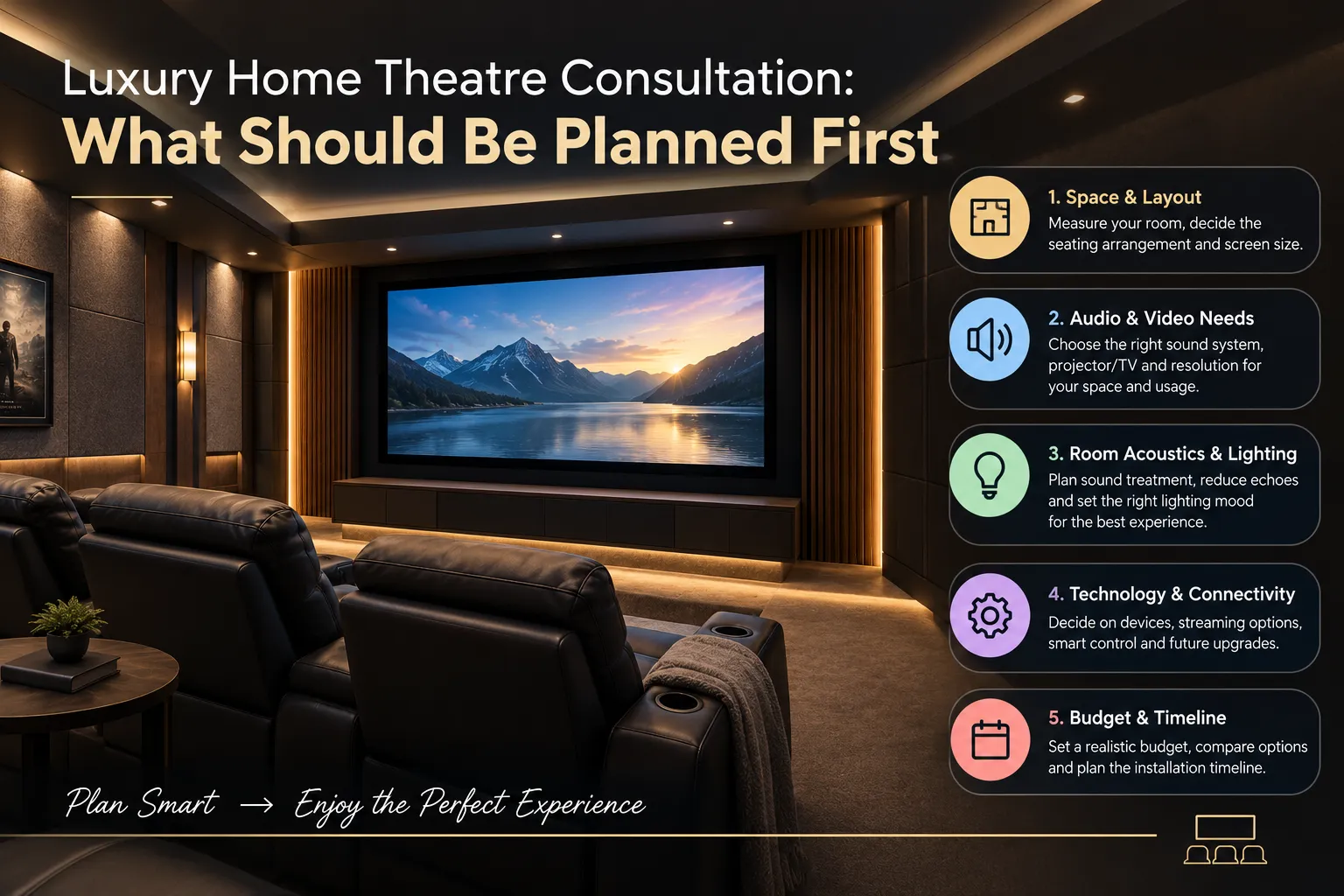
A luxury home theatre consultation is a structured planning conversation held before equipment is chosen. Its purpose is to match the room, the household’s habits and the budget to a realistic design. The main topics are:
- Lifestyle and use: films, sport, gaming, music or all four. This sets the priorities.
- Room dimensions, shape and ceiling height: these shape speaker choice and seating options.
- Seating layout and viewing distance: these decide screen size and speaker positions.
- Acoustics and sound isolation: the room’s reflections, bass behaviour and sound leakage to neighbouring rooms.
- Screen, projector and speaker selection: made after the room is understood, not before.
- Power, racks and ventilation: dedicated circuits, equipment space and airflow.
- Interior design coordination: finishes, joinery, ceiling details and concealed speakers.
- Integration, commissioning and handover: control programming, calibration and training.
Early involvement removes avoidable compromises. A seat placed against the rear wall, for example, changes bass behaviour and speaker choice. Moving it later may be impossible once the joinery is built.
Best Smart Home Automation Systems for Luxury Residences
No single platform is best for every luxury home automation. The right system follows the project brief, the construction stage, the integrations required and the local service ecosystem. Evaluate options against these factors:
| Decision factor | What to ask |
|---|---|
| Wired or wireless | Is cabling possible at this stage? Wired buses suit new builds, while wireless suits retrofits. |
| Lighting and scenes | Can circuits be dimmed and grouped into scenes? |
| Blinds and curtains | Are motors compatible with the control platform? |
| Climate and security | Which integrations are essential, and which are optional? |
| AV and multi-room audio | Does the platform have mature control of cinema and music equipment? |
| Local operation | What still works if the internet fails? |
| Expansion and service | Can a qualified integrator maintain and extend it for years? |
← Scroll table on mobile →
Three platform families come up most often. KNX is an open, wired standard (ISO/IEC 14543-3 and EN 50090) with devices from many manufacturers. It suits lighting, blinds and climate control where cabling is planned early. It is not an AV controller, so it is usually paired with a separate AV control layer.
Control4 and Crestron are professionally installed control platforms with strong AV integration. Crestron projects typically involve custom programming by certified programmers. Wireless ecosystems can suit smaller or retrofit projects, but confirm local operation and long-term support first.
Home Theatre Design and Installation Services: From Concept to Commissioning
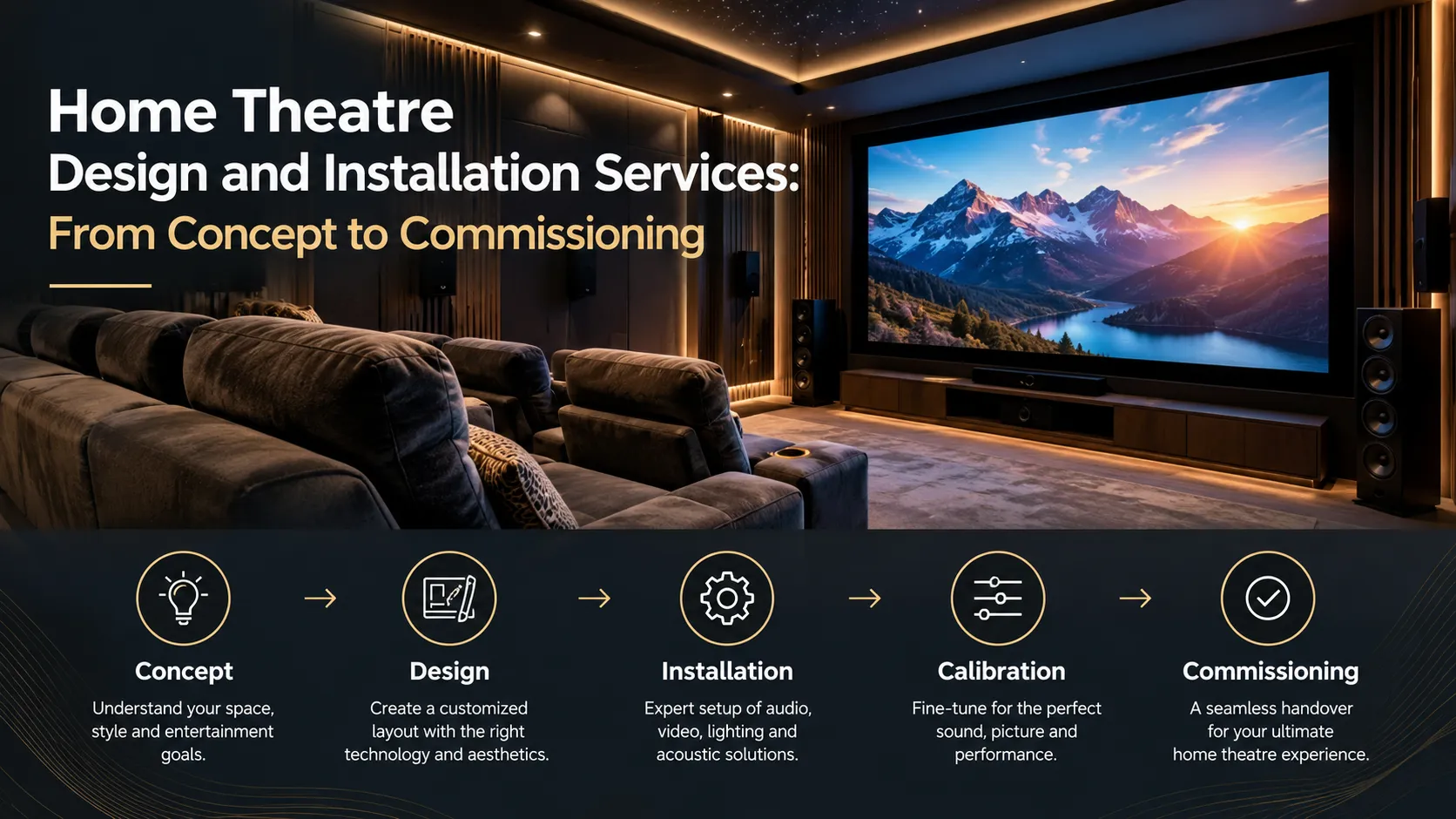
Professional home theatre design and installation services follow a sequence, because each phase depends on the one before. The purpose of each phase is:
- Discovery and consultation: understand the household, the room and the experience wanted.
- Technical planning: measure the space, review structure, services and noise sources.
- System design and specification: define the layout, equipment and control, with an itemised scope.
- Coordination with architects and designers: align ceilings, joinery, lighting and finishes with technical needs.
- Cable routing, power and equipment preparation: install conduits, circuits and rack provisions at the right construction stage.
- Installation and integration: mount and connect equipment, then program the control system.
- Acoustic and audio calibration: measure and tune the room so the system performs as designed.
- Testing, user training and handover: verify every function, train the household and supply documentation.
The home theatre design and installation service page provides a better understanding of the Design and installation work.
Planning a Dolby Atmos Home Cinema Setup
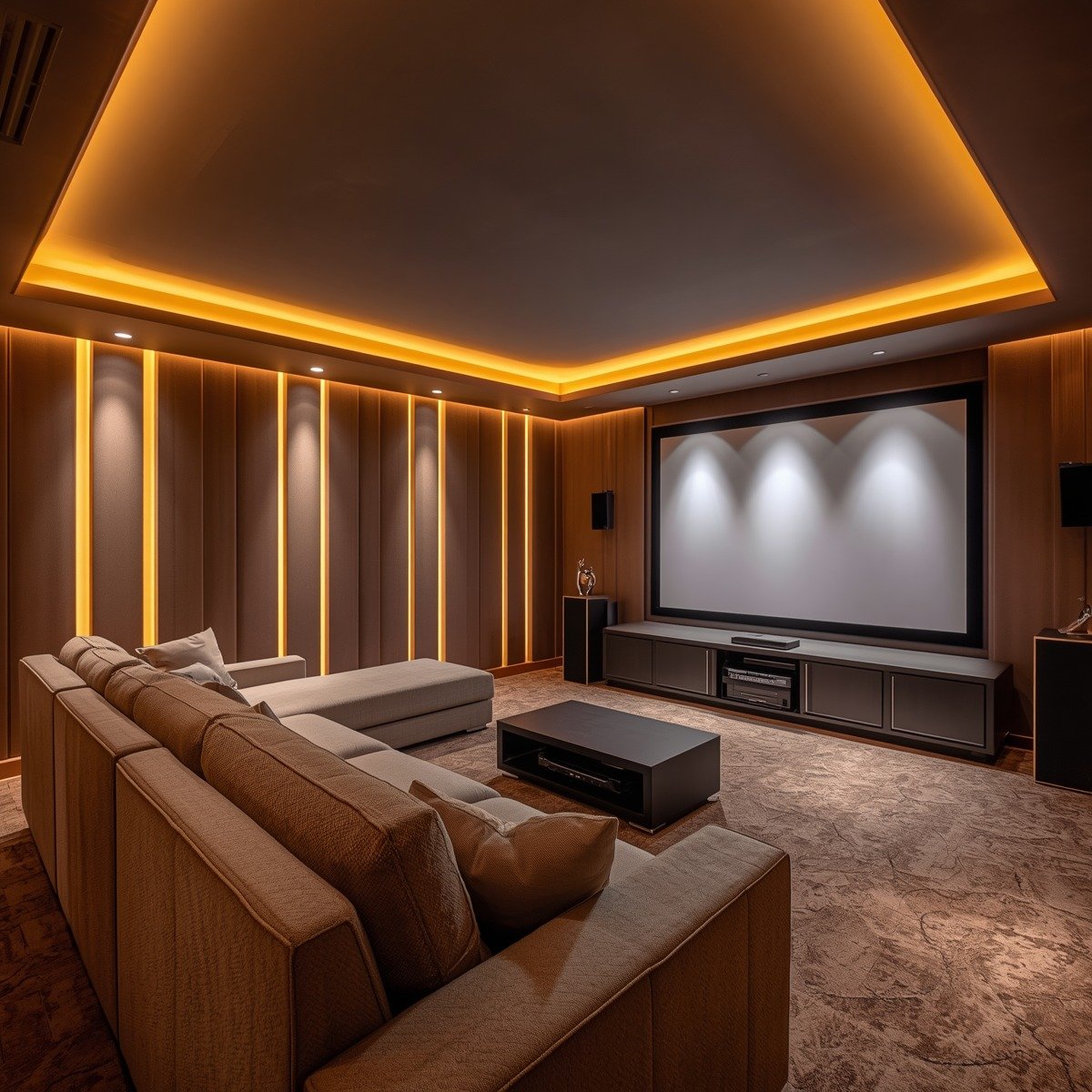
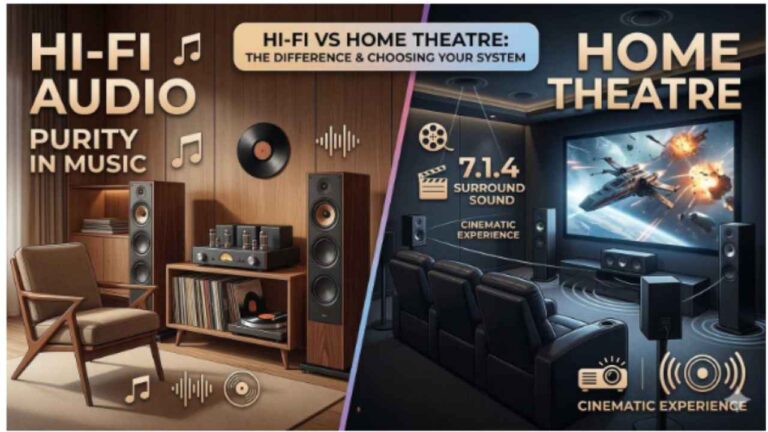
Dolby Atmos is an object-based immersive audio format. Conventional surround sound assigns audio to fixed channels, such as left, right and rear. Atmos instead describes sounds as objects with positions in three-dimensional space. The AV processor then renders them to whichever speakers the room contains, including overhead speakers.
Channel notation such as 5.1.2 or 7.1.4 has three numbers. The first counts ear-level speakers. The second counts subwoofers. The third counts overhead speakers. A 7.1.4 layout therefore has seven ear-level speakers, one or more subwoofer and four overhead speakers. Some designs use two subwoofers, written as 7.2.4.
A higher count is not automatically better. The right configuration depends on:
- Ceiling height and construction: overhead speakers need suitable positions and clearance.
- Seat positions: every seat should be placed with the speaker layout in mind.
- Room size and shape: a small room may sound better with fewer, well-placed speakers.
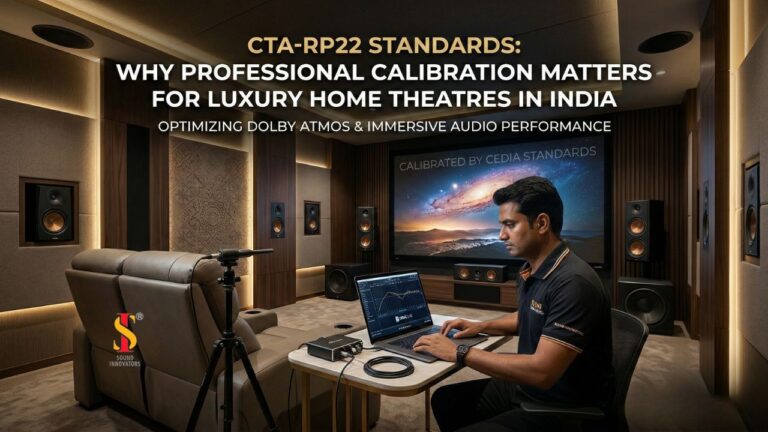
Acoustic treatment, bass management and calibration complete the picture. Bass management decides how low frequencies are shared between speakers and subwoofers. Calibration measures the result at the seats and adjusts levels, timing and equalisation. Hardware without this step rarely delivers its potential. Dolby publishes placement guidance for overhead speakers, which a designer should apply to the actual room.
To learn more about dolby system: What is a Dolby Atmos Home Cinema Setup? Complete Guide for Indian Homes
A 5.1.2 and a 7.1.4 can be right for different rooms, and the room decides. Send us your room dimensions and ceiling height, and we will discuss which direction makes sense before you commit to any equipment.
High-End Hi-Fi Audio: Creating a Dedicated Listening Experience
Serious music listening has different demands from cinema. The aim is accurate, natural reproduction of a recording, usually in stereo. Sound Innovators works as a high-end Hi-Fi audio system provider and consultancy for homeowners who want this level of detail.
The main considerations are:
- Speaker and amplifier matching: sensitivity, impedance and power should suit each other and the room.
- Listening position and placement: distance from walls and between speakers changes bass, imaging and tonal balance.
- Room reflections: hard surfaces, glass and open volumes colour the sound. Treatment can be discreet.
- Source components: a digital-to-analogue converter (DAC) turns digital files into the analogue signal. Streaming and network players feed it.
- Interior integration: finishes, furniture and speaker positions should be agreed together.
A dedicated listening room and whole-home music are different projects. The first optimises one room for critical listening. The second distributes music to several zones, where convenience and consistency matter more than a single sweet spot. Many homes need both, planned separately.
Integrating Home Theatre, Music, Lighting and Automation
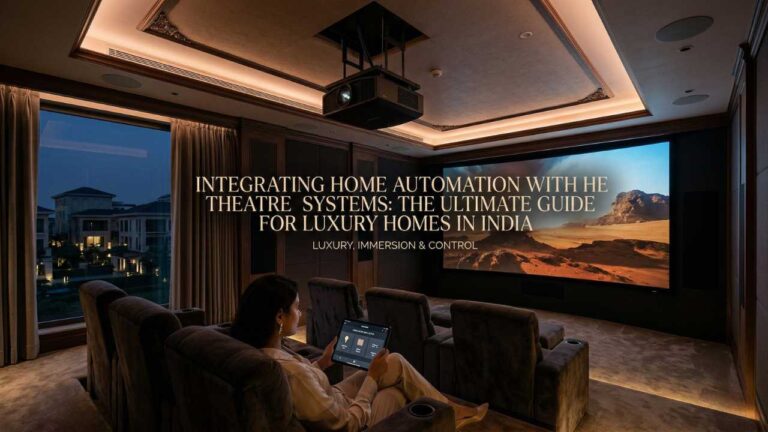
Integration means one control system coordinating separate technologies. Consider a “Movie” scene. One touch dims compatible lights, closes the motorised curtains, lowers the screen and powers on the projector and AV processor. It then selects the source and sets the volume. A “Music” scene might instead raise the lights and select a playlist.
This removes the need for a drawer of remotes and fragmented apps. Household members and staff learn one interface.
Reliable integration depends on planning:
- Compatibility: confirm that each product has a supported control method before purchase.
- Network design: plan switches, wireless coverage and addressing, since many devices rely on the network.
- Control interfaces: choose touch panels, apps and keypads for how people actually use the room.
- Manual fallback: wall switches and native remotes should still work if the control system is offline.
Mumbai vs Pune: What Should Luxury Homeowners Consider?
Properties vary within each city, so treat the following as possibilities rather than rules. A site assessment confirms what applies.
Mumbai
Mumbai. Many premium homes are high-rise apartments and penthouses, where space is limited. Slab heights, beams and service ducts can restrict ceiling speakers and equipment locations. Building rules may govern drilling and working hours. Sound isolation matters because neighbours are close, and the ambient noise outside can affect quiet listening. Equipment racks need planned ventilation, since heat builds up in enclosed cabinets.
Pune
Pune. Villas, row houses and larger residences often offer more flexibility. New construction can accommodate a dedicated cinema room, planned ceiling heights and conduits from the start. Early coordination with the architect is the biggest opportunity here. Larger floor plans also raise questions about cable lengths, multiple zones and outdoor entertaining.
In both cities, the principle is the same. The earlier the AV specialist joins, the fewer constraints are fixed by the time they are consulted.
How to Choose a Luxury Residential AV Consultant
Use this checklist when comparing consultants:
- Relevant design and integration experience in residential projects.
- Understanding of room acoustics and immersive audio.
- Willingness to coordinate with architects and interior designers.
- Clear specifications and itemised proposals.
- Equipment compatibility and an upgrade path.
- Testing, calibration and written documentation.
- Defined after-sales support and service arrangements.
- Credentials and project references you can verify.
Common Planning Mistakes to Avoid
| Mistake | Why it matters | Prevention |
|---|---|---|
| Finalising the room before consulting an AV specialist | Dimensions, ceilings and seating become hard to change | Involve a specialist at concept stage |
| Choosing speakers before understanding the room | The room strongly affects how speakers sound | Select equipment after the site survey |
| Ignoring acoustics and subwoofer placement | Bass can be uneven between seats | Plan treatment and test placements |
| Underestimating ventilation and equipment space | Heat shortens equipment life and may cause shutdowns | Allocate rack space, airflow and cooling early |
| Treating automation and AV as separate systems | Control becomes fragmented | Agree one control strategy in the design |
| Skipping cable routes and future expansion | Retrofits mean cutting finished walls | Install spare conduits and documented routes |
| Overlooking commissioning and support | Systems may never be tuned or serviced | Include calibration, training and a service plan in scope |
← Scroll table on mobile →
Frequently Asked Questions
What is included in a luxury home theatre consultation?
It typically covers your usage goals, room dimensions, seating, acoustics, equipment options, power and ventilation needs, interior coordination and control integration. The outcome is a clear technical direction and scope. Detailed recommendations still depend on a site assessment of the actual room.
Which smart home automation system is best for a luxury residence?
There is no single best system. KNX, Control4 and Crestron each suit different briefs. The right choice depends on the construction stage, the integrations required, your preference for wired or wireless architecture and the availability of qualified local service support.
How should homeowners plan a Dolby Atmos home cinema?
Start with the room: ceiling height, seat positions and acoustics. Then choose a speaker layout that suits the space, such as 5.1.2 or 7.1.4, with compatible processing, amplification and calibration. More channels do not always improve a smaller room, so let the room guide the decision.
Can home theatre systems integrate with smart lighting and curtains?
Yes, provided the products support a compatible control method. A single scene can dim lights, close curtains and power on the AV equipment. Confirm compatibility during design rather than after purchase, and keep manual controls as a fallback if the control system is offline.
Why should AV planning happen before interior work is finalised?
Speaker positions, ceiling details, cable routes, ventilation and seating affect both performance and appearance. Planning early lets the AV design and the interior design shape each other. This reduces visible compromises and avoids costly alterations to finished walls, ceilings and joinery later.
What is the difference between a home theatre and a high-end Hi-Fi system?
A home theatre is built around film, with a screen and multi-channel surround or Atmos sound. A high-end Hi-Fi system focuses on music reproduction, usually in stereo. The two can coexist in one home, often in separate rooms with different acoustic priorities and equipment.
Can a luxury home theatre be designed for an existing apartment?
Often, yes, within the limits of the structure. A survey reviews ceiling height, wall construction, sound isolation and equipment locations. Concealed speakers, compact racks and careful acoustic treatment can work well, though a purpose-built dedicated room offers more design freedom.
What should homeowners evaluate before selecting an AV consultant in Mumbai or Pune?
Look for relevant residential experience, acoustic understanding, clear itemised proposals, coordination with architects, calibration and documentation, and defined after-sales support. Ask for verifiable references rather than relying on claims, and confirm who will service the system and under what terms after handover.
Plan Your Luxury Home Theatre Consultation
The best results begin with a conversation about the room, the experience you want and the constraints of your design. Homeowners, architects and interior designers are all welcome to share plans early, even before the layout is fixed. Plan Your Luxury Home Theatre Consultation, or explore further technical guides on Connect with us.