Best Home Theatre Setup for a Square Room in India (Cylindrical WaveForming Explained)
- 01Why Square Rooms Cause Home Theatre Problems
- 02What Is Cylindrical WaveForming?
- 03How Many Subwoofers Does WaveForming Actually Need?
- 04What Is Infrasonic Bass and Why Does It Matter?
- 05Can You Get True Dolby Atmos Sound in a Small or Square Room?
- 06Is a Luxury Home Theatre Consultation Necessary Before Construction?
- 07Why Early Planning Beats Retrofitting
- 08What Does a High-End Hi-Fi Audio System Provider Actually Do?
- 09Bringing This to Indian Homes
- 10Frequently Asked Questions
- 11The Takeaway
Why Square Rooms Cause Home Theatre Problems
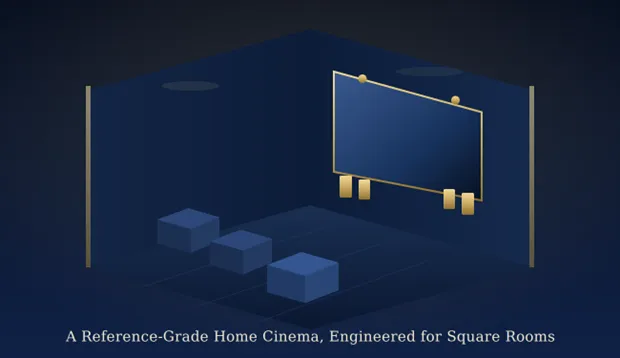
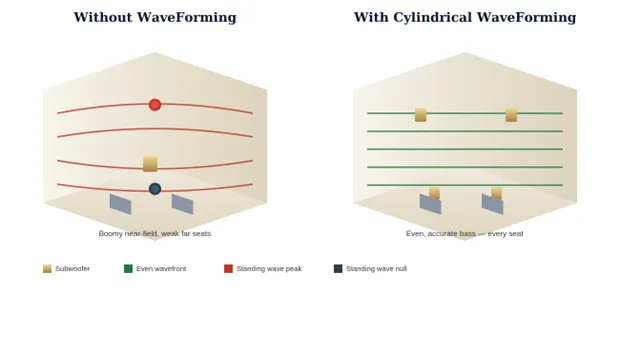
Most Indian luxury apartments and villas have compact, square, or near-square rooms. This shape is common because of land cost and floor-plan efficiency, not acoustic design. Unfortunately, square rooms are the worst shape for bass. Parallel walls reflect low frequencies back and forth, creating “standing waves” spots where bass booms and spots where it disappears.
If you’ve ever sat in a home theatre where one seat sounds powerful and the next sounds flat, you’ve experienced this. It’s not a speaker problem. It’s a room-shape problem, and it has a specific, provable technical fix.
What Is Cylindrical WaveForming?
Cylindrical WaveForming is a patented bass technology from Trinnov Audio. Instead of correcting standing waves after they form, it prevents them from happening at all. It uses a floor-level front subwoofer array, plus rear subwoofers, to control how bass waves travel through the room.
The result: consistent, accurate bass in every seat, not just the “reference seating spot.” It was demonstrated publicly at Audio Advice Live 2026 in Raleigh, North Carolina, in a system built by ASCENDO Immersive Audio, Trinnov, and Christie using Trinnov’s flagship AltitudeCI processor and ASCENDO’s THE18 SUB subwoofers.
Key facts about Cylindrical WaveForming:
Requires minimum 4 subwoofers to function
Needs far less architectural change than older planar bass-correction systems
Improves transient accuracy, not just loudness
Works alongside a full Dolby Atmos, DTS:X & Aura-3D home cinema configuration, including height channels
Pairs with infrasonic subwoofers for frequencies below its normal range
How Many Subwoofers Does WaveForming Actually Need?
A minimum WaveForming array uses four subwoofers two along the front wall and two along the rear wall. Larger rooms, like the 25′ x 25′ demo room at Audio Advice Live 2026, use more subwoofers for a stronger effect. For most Indian home theatre rooms, four to eight subwoofers is a realistic, space-efficient target.
What Is Infrasonic Bass and Why Does It Matter?
Infrasonic bass covers frequencies below WaveForming’s normal operating range the deepest, most physical layer of sound. A dedicated infrasonic subwoofer delivers bass you feel in your chest, not just hear through the speakers. In premium systems, this is treated as a separate, complementary layer to the main subwoofer array, not a replacement for it.
Can You Get True Dolby Atmos Sound in a Small or Square Room?
Yes. Dolby Atmos does not require a very large or rectangular room. It requires correct speaker placement front, surround, and height channels combined with accurate bass management. Cylindrical WaveForming solves the bass half of that equation, which is historically the hardest part to get right in a compact Indian home theatre.
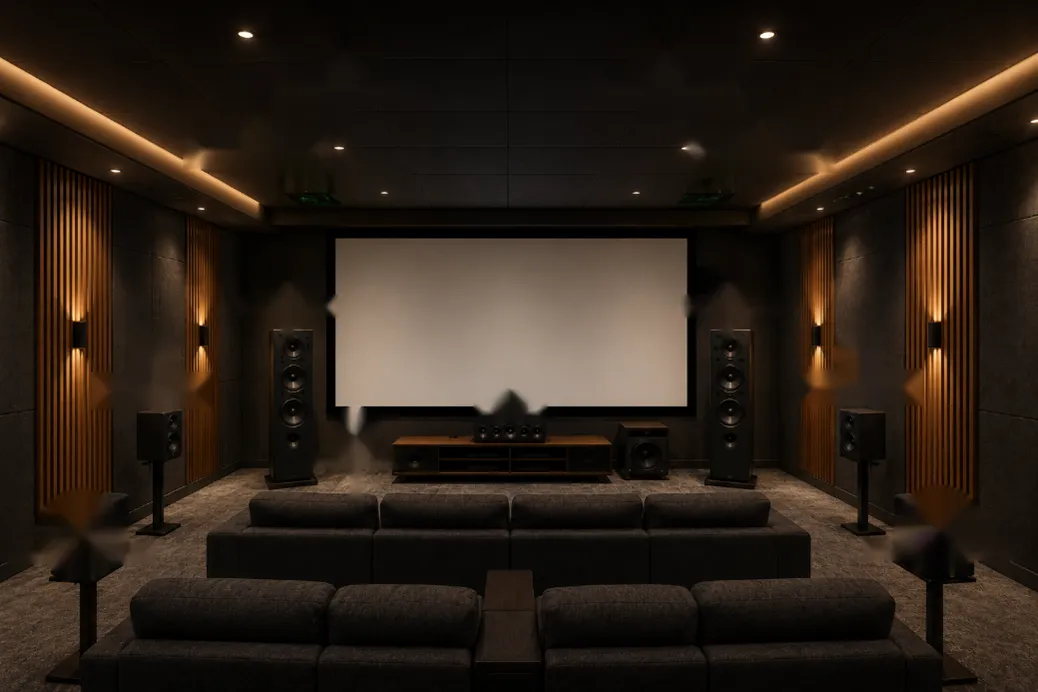
A properly designed Dolby Atmos home cinema setup in a square room needs:
Front left, center, and right channel speakers
Side and rear surround speakers
Top speakers for overhead effects
A WaveForming-style subwoofer array for even bass
Room-correction processing to tune the full system
Is a Luxury Home Theatre Consultation Necessary Before Construction?
Yes, and this is the single biggest factor in getting a great result. Subwoofer placement, wiring conduits, and room dimensions all need planning before walls, flooring, and ceilings are finalized. A Luxury Home Theatre Consultation in India, done during the design phase, costs far less to implement than retrofitting the same system after handover.
Architects, builders, and interior designers who involve an AV consultant early avoid two common problems: hidden wiring conflicts and subwoofer positions that no longer fit once furniture and décor are finalized.
Why Early Planning Beats Retrofitting
Retrofitting a finished room is always harder than planning ahead. Conduits are already sealed. Furniture layouts are already fixed. Wall finishes are already applied. Every change becomes a compromise rather than a clean installation.
This is why home theater design and installation services in India increasingly work directly with architects during the blueprint stage, not after the interiors are complete. It’s the same reason plumbing and electrical planning happen early acoustic planning deserves the same discipline.
What Does a High-End Hi-Fi Audio System Provider Actually Do?
A qualified High-End Hi-Fi Audio System provider does more than sell speakers. They assess the room, calculate subwoofer and speaker placement, select components suited to the space, and calibrate the finished system using measurement tools not guesswork. This is the same standard used in professional cinema installations, scaled for a home.
Bringing This to Indian Homes
Sound Innovators works as an ASCENDO Immersive Audio partner and they are Trinnov audio Certified Engineers, bringing this exact subwoofer-array approach into Mumbai and Pune residences. In practice, that means:
Room assessment before construction locks the layout
Subwoofer array planning using the WaveForming principle
Full Dolby Atmos integration, including height channels and object-based audio
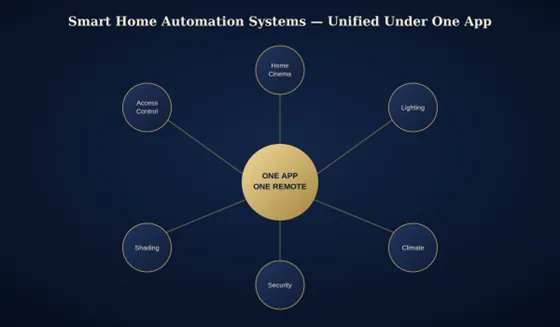
Smart home automation systems in India lighting, shading, and climate unified with the AV system
System calibration using the same measurement-driven process shown at global AV events
Audio, lighting, climate, and security unified under one app and one remote.
Frequently Asked Questions
The Takeaway
A square room is not a limitation your home theatre has to live with. Cylindrical WaveForming, paired with correct Dolby Atmos design, turns India’s most common room shape into a solvable engineering problem rather than a permanent compromise.
Sound Innovators, as an ASCENDO Immersive Audio partner and Trinnov audio Certified Engineers, brings this exact approach to Indian homes from early-stage consultation through full Dolby Atmos and smart home integration. For homeowners, architects, and builders planning a home cinema, the right conversation, held early, is what separates an average room from a reference-quality one.