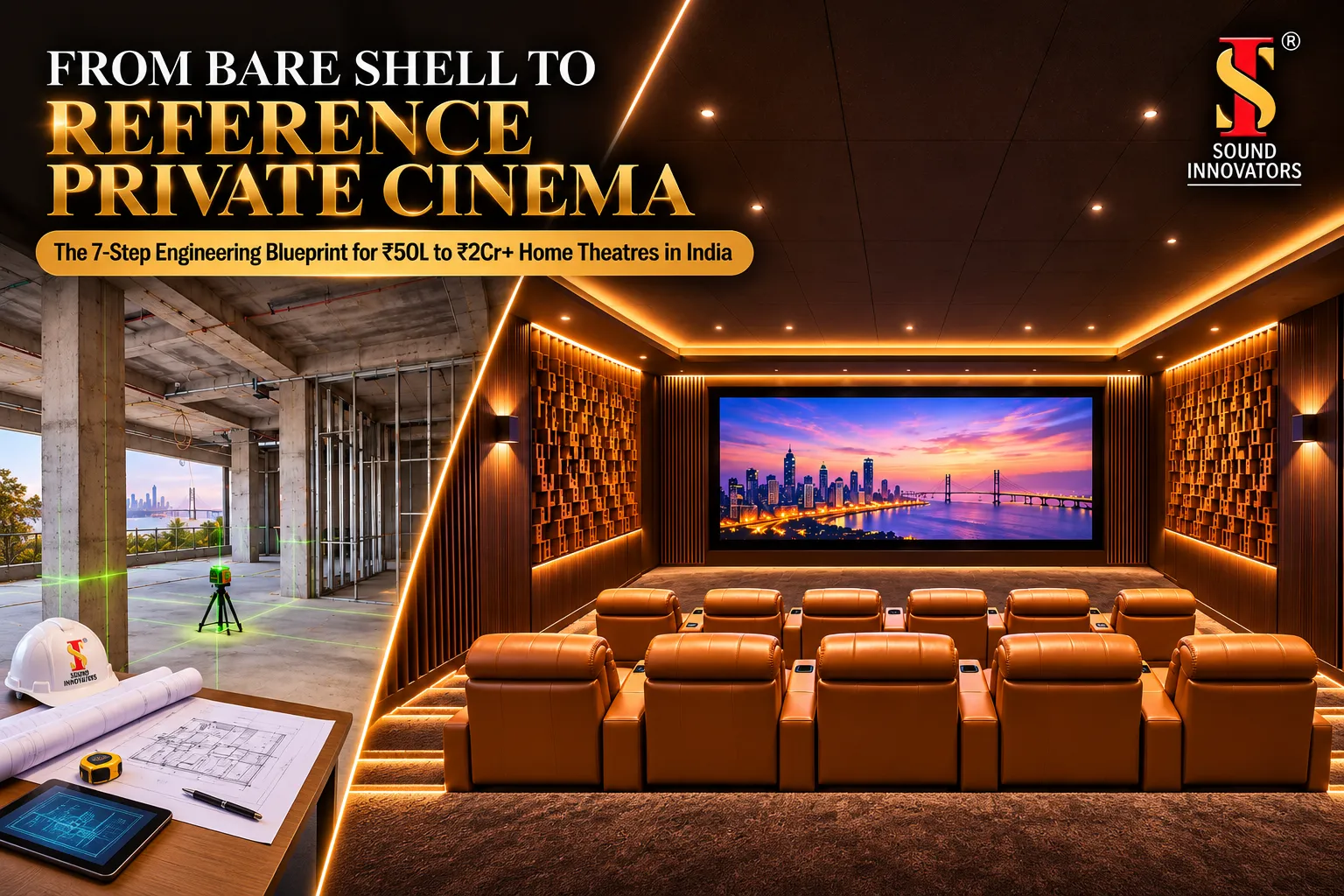
From Bare Shell to Reference Private Cinema: The 7-Step Engineering Blueprint for ₹50L to ₹2Cr+ Home Theatres in India
Why Equipment Quotes Fail Without an Engineering Blueprint
From Bare Shell to Reference Private Cinema: The 7-Step Engineering Blueprint for ₹50L to ₹2Cr+ Home Theatres in India begins long before a single loudspeaker, laser projector, or motorized recliner is ordered. When you invest between ₹50 lakhs and ₹2 crores or more in a luxury residence across Mumbai, Pune, Goa, Delhi, Bengaluru, or Hyderabad, commissioning a reference private cinema is an architectural engineering project rather than a retail electronics purchase.
Consequently, the most expensive mistake affluent homeowners make is approaching a dedicated reference private cinema room by collecting hardware box quotes from retail dealers. A dealer quote lists prestigious brand names on a spreadsheet, yet it completely ignores how sound waves, low-frequency air pressure, structural concrete slabs, air-conditioning ducting, and interior joinery interact inside your physical room. Therefore, even ₹1 crore of world-class loudspeakers will sound muddy, boomy, and fatiguing if they are installed inside an uncalibrated room with marble floors, untreated parallel walls, and vibrating false ceilings.
At Sound Innovators, our CEDIA-certified engineering team brings over 18 years of specialized experience and 87+ global certifications to design bespoke home theatres in India. Rather than selling boxed packages, our luxury AV consultancy integrates into your project at the bare-shell stage. In this comprehensive step-by-step blueprint, you will learn the exact seven-phase engineering sequence required to transform a raw concrete shell into a verifiable reference private cinema with zero construction rework.
Building a reference private cinema for ₹50L to ₹2Cr+ home theatres in India requires a seven-step engineering sequence executed between RIBA Stages 0 and 6: (1) Bare-shell floor-plan feasibility and lifestyle briefing, (2) 3D modal and acoustic simulation per CEDIA/CTA-RP22, (3) Structural shell isolation and silent NC-20 HVAC engineering, (4) Baffle wall, riser, and concealed electrical conduit routing, (5) Precision loudspeaker, amplifier, and optical projection specification, (6) Dust-free rack integration and KNX/Crestron scene programming, and (7) Measurement-based Trinnov, Dirac Live, and RP32 room calibration.
- Why Equipment Quotes Fail Without an Engineering Blueprint
- What Defines a True Reference Private Cinema in India?
- Why Retail Hardware Quotes Cause ₹5L to ₹15L in Site Rework
- The 7-Step Engineering Blueprint for a Reference Private Cinema
- Section 04: Real-World Proof: Flagship Reference Private Cinema Projects in India
- Section 05: Investment Allocation: Where Your ₹50L to ₹2Cr+ Budget Actually Goes
- Mumbai High-Rise Penthouses vs. Pune, Goa & Pan-India Luxury Villas
- Frequently Asked Questions (FAQs) About Building a Reference Private Cinema
- Conclusion & Next Step: Submit Your Floor Plan for a RIBA Stage 0 to 2 Feasibility Study
What Defines a True Reference Private Cinema in India?
Moving Beyond Retail Home Theatres to Objective Engineering Standards
To understand why a ₹50L to ₹2Cr+ installation belongs in a completely different category from a living-room media setup, we must first define what “reference” actually means in cinema engineering. In a commercial dubbing stage or a luxury reference private cinema, the goal is to reproduce the film director’s exact audio and visual master without room-induced distortion, structural rattling, or dialogue masking.
Specifically, professional home theatres in India are no longer judged by subjective opinions or speaker counts alone. Instead, modern engineering follows the CEDIA/CTA-RP22 Immersive Audio Design Recommended Practice, which replaces vague marketing terms with four objective, measurable performance tiers.
| CEDIA/CTA-RP22 Level | Performance Classification | Peak SPL & Headroom Target | Typical Indian Property Application | Estimated Turnkey Investment |
|---|---|---|---|---|
| RP22 Level 1 | Entry Performance | 97 dB peak SPL at Reference Seating position | Multi-use apartment family lounge or media room | ₹25 Lakhs to ₹55 Lakhs |
| RP22 Level 2 | Enhanced Commercial Cinema | 105 dB main channels / 117 dB LFE bass | Penthouse or villa reference private cinema | ₹50 Lakhs to ₹1.5 Crore |
| RP22 Level 3 | Reference Director’s Stage | 108 dB main channels / 120 dB LFE with tight seat-to-seat consistency | Luxury villa reference private cinema | ₹90 Lakhs to ₹3.75 Crore |
| RP22 Level 4 | Ultra-Reference Mastering Cinema | 116 dB+ peak capability with sub-10 Hz Infrasonic response (Over 85dB continuous calibration tone) |
Reference private cinema screening room or commercial preview theatre | ₹3.7 Crore + (No Fix budget) |
← Scroll table on mobile →
Furthermore, achieving RP22 Level 2, Level 3, or Level 4 performance inside Indian luxury residences presents unique architectural challenges. Unlike timber-framed houses in North America or Europe, luxury residences in India are constructed using high-density reinforced cement concrete (RCC) columns, post-tensioned floor slabs, brick or AAC block masonry, and highly reflective Italian marble or vitrified stone flooring.
Why Indian Concrete Shells Demand Specialized Acoustic Physics
When low-frequency bass energy between 20 Hz and 120 Hz is generated by high-powered subwoofers inside a sealed concrete reference private cinema room, the sound energy cannot flex the walls and escape. Consequently, the bass reflects back into the room, colliding with incoming waves to create severe standing waves (room modes). Without mathematical simulation before interior carpentry begins, one recliner row will experience overwhelming, chest-crushing boominess while the row directly behind it experiences a complete bass cancellation null.
Moreover, in high-rise Mumbai penthouses across Worli, Lower Parel, Cuffe Parade, and Bandra, post-tensioned concrete slabs transmit structural vibrations directly into the bedrooms or neighbours below. Therefore, a true reference private cinema must be engineered from the bare structural shell upward. For a broader overview of how residential entertainment ecosystems fit into modern estates, explore our recent guide on Audio Visual Solutions for Luxury Homes.
Why Retail Hardware Quotes Cause ₹5L to ₹15L in Site Rework
The Costly Trap of Calling an AV Vendor at RIBA Stage 4
Across India, over 70% of luxury residential projects bring in an audio-visual vendor far too late in the construction timeline. Typically, the civil walls are plastered, the HVAC air-conditioning ducts are hung, the false ceiling gypsum grid is framed, and the interior designer has finalized the wall panelling before anyone asks where the reference private cinema equipment will go.
In architectural terms, defined by the RIBA Plan of Work Framework, waiting until Stage 4 (Technical Design completed) or Stage 5 (Manufacturing and Construction) forces catastrophic compromises. At that late stage, your only options are either settling for compromised sound and visible wires or paying for expensive demolition.
| Planning Failure on Site | Architectural & Performance Consequence | Typical Demolition & Rework Cost in India |
|---|---|---|
| Finalizing room dimensions without modal analysis | Acoustic standing waves create boomy bass and muddy dialogue across seating rows | ₹2,00,000 to ₹5,00,000 for structural acoustic retrofits |
| Closing false ceilings before Atmos & throw calculations | Overhead speakers miss the 45-degree listening axis and projector throw distance is blocked by beams | ₹80,000 to ₹2,50,000 to demolish and rebuild gypsum ceilings |
| Installing standard residential split ACs in the theatre | 42 dBA blower noise destroys the quiet noise floor required for cinema dynamics | ₹1,50,000 to ₹7,00,000 to re-duct silent low-velocity reference private cinema HVAC |
| Buried HDMI 2.0 cables or unshielded electrical conduits | 4K/120Hz and 8K signal dropouts, ground-loop hum, and zero upgrade path without cutting walls | ₹1,50,000 to ₹5,00,000 for re-chasing walls and optical fiber replacement |
| Undersized carpentry cabinets for AV amplification racks | Thermal shutdown of Class-A/AB amplifiers and processor failure due to trapped heat | ₹75,000 to ₹2,00,000 to rebuild ventilated equipment joinery |
| Total Avoidable Rework Exposure | 4 to 8 weeks of project delay and ruined interior finishes | ₹6,55,000 to ₹17,50,000+ in completely avoidable waste |
← Scroll table on mobile →
As a result, our luxury home theatre consultation begins strictly between RIBA Stage 0 (Strategic Definition), Stage 1 (Preparation and Briefing), and Stage 2 (Concept Design). We recently published a dedicated breakdown for design professionals explaining Why Interior Designers Should Involve a Home Theatre Consultant Before Finalizing Room Dimensions. When your architect, interior designer, electrical contractor, and AV engineer align at the bare-shell stage, every conduit, acoustic cavity, and structural riser is built right the first time for your reference private cinema.
The 7-Step Engineering Blueprint for a Reference Private Cinema
Building a world-class reference private cinema follows a strict, deterministic sequence. Each engineering milestone locks in physical parameters required by the next stage. Below is the complete 7-step methodology we execute across India’s finest villas, penthouses, and private screening rooms.
Step 1: Bare-Shell Feasibility, Lifestyle Briefing, and Floor-Plan Audit (RIBA Stage 0 to 1)
Every landmark reference private cinema starts with an architectural floor-plan audit and a deep discovery session with the homeowner’s family and principal architect. Before discussing any equipment brand, our engineering team evaluates how the room will actually be lived in.
1. Defining Primary Experience Priorities
First, we establish whether the space is a pure dedicated reference private cinema room, a commercial-grade DCI preview theatre for first-day-first-show film screenings, or a dual-purpose reference cinema and high-fidelity music lounge. For example, our 30-Seater Dolby Atmos Preview Theatre in Juhu, Mumbai required commercial screening precision, whereas our Candolim Goa 5-Suite Luxury Beach Mansion integrated a 25.8 channel Dolby Atmos cinema alongside whole-home Crestron and KNX automation.
2. Auditing Structural Shell Dimensions and Dimensional Ratios
Next, we require your architectural floor plan and section drawings (in AutoCAD DWG or scaled PDF format) showing raw slab-to-slab height, structural beam drops, column projections, window openings, and adjacent room usage. Using acoustic ratio formulas (such as Sepmeyer, Louden, and Bonello modal distribution criteria), we check whether the raw length, width, and height will trigger severe axial or tangential frequency pile-ups.
- Ideal minimum shell size for a 9 seat villa reference private cinema: 27 ft (Length) x 18 ft (Width) x 14 ft (Clear Slab Height).
- High-rise penthouse shell adaptation: Where slab heights are restricted to 9.5 or 10.5 feet, we engineer low-profile structural isolation and directional angled overhead transducers to preserve vertical soundstage height.
3. Establishing the Turnkey Investment Tier Early
During Step 1, we align your room volume and seating capacity with a realistic turnkey budget tier between ₹50 lakhs and ₹2 crores+. You can review component-level market benchmarks in our Home Theatre Cost in India 2026: Complete Price Guide, where Tier 4 (₹50L to ₹1.5Cr) and Tier 5 (₹1Cr to ₹3Cr+) outline the exact investment required for dedicated reference private cinema rooms.
Step 2: 3D Acoustic Simulation, Modal Mapping, and Sightline Geometry (RIBA Stage 2)
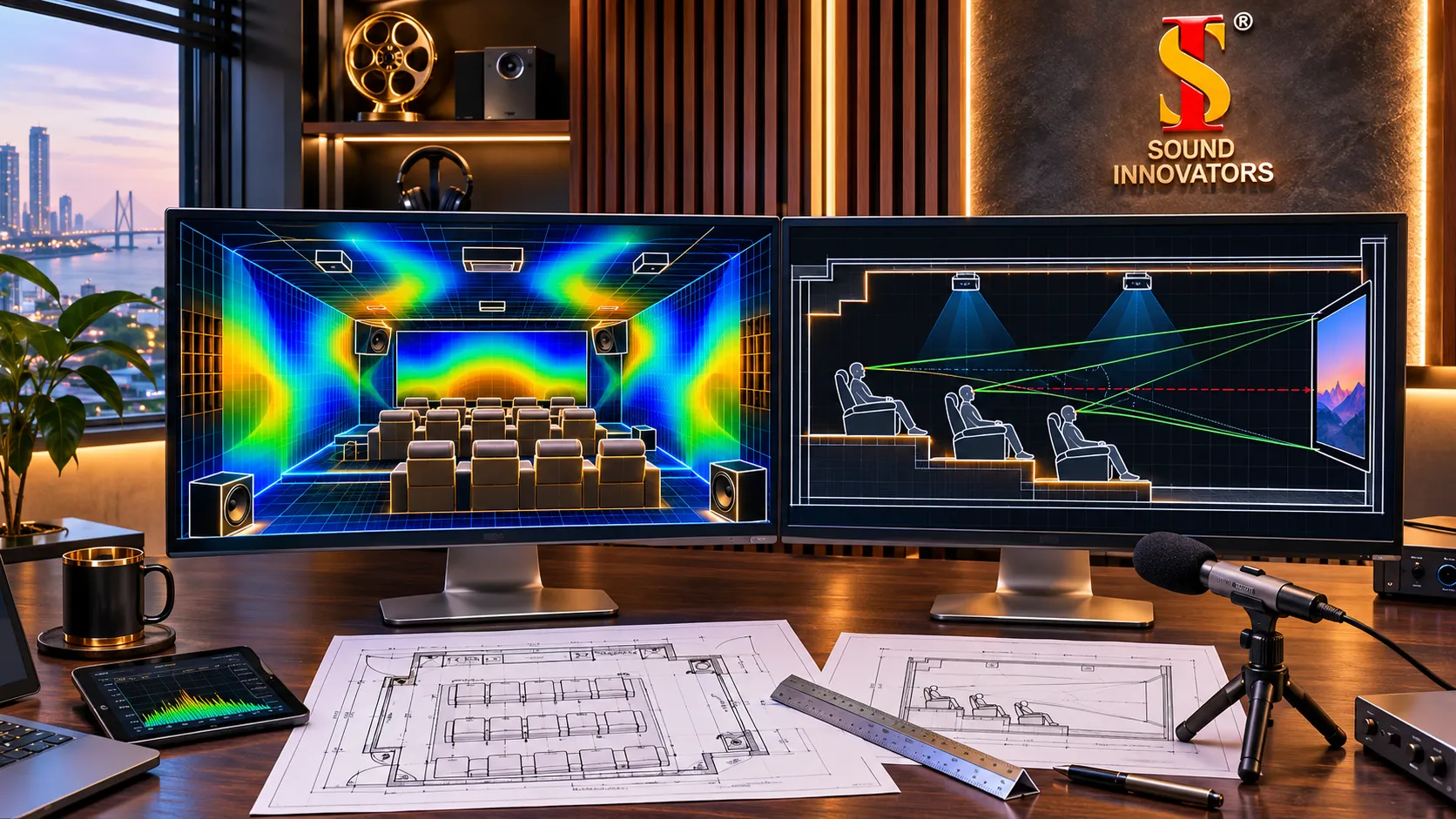
Physics-based 3D acoustic simulation mapping subwoofer pressure zones and CEB23 sightline geometry before construction (Sound Innovators, 2026)
Once the floor plan is audited, we move to Step 2 of the reference private cinema blueprint: building a physics-based 3D digital twin of your room. At Sound Innovators, we charge a 10% of total equipment cost as consultancy and engineering simulation fee (which is 100% credited back against your turnkey hardware procurement within four months) so that every decision is backed by mathematical proof rather than guesswork.
1. Low-Frequency Modal Mapping and Cylindrical WaveForming
Below the Schroeder transition frequency (typically between 80 Hz and 180 Hz in residential reference private cinema rooms), sound behaves like waves in a small tank rather than rays of light. Our acoustic simulation models the exact standing-wave pressure zones across every seat in every row.
- Multi-Subwoofer Distributed Arrays (7.4.4 / 9.4.6): By placing four or more subwoofers at calculated quarter-wall or corner boundaries and aligning their phase and delay, we cancel destructive room modes.
- Trinnov Cylindrical WaveForming: For square rooms or ultra-reference builds (such as 9.6.6 or 16.8.6 layouts), we design front-wall emitter arrays and rear-wall absorber subwoofer arrays that launch a planar wavefront across the room and actively eliminate rear-wall bass reflections.
2. Sightline Geometry and Stadium Riser Engineering (CEB23 Standards)
A reference private cinema with two or three rows of motorized luxury recliners fails immediately if second-row viewers see the heads of first-row viewers blocking the bottom 15% of the CinemaScope screen. Following CTA/CEDIA-CEB23 video design formulas, we calculate:
- Horizontal Viewing Angles: Maintaining a 45-degree to 55-degree horizontal field of view for 2.40:1 CinemaScope immersion without causing neck strain.
- Vertical Viewing Angles: Keeping the vertical eye-to-screen center angle under 5 degrees so viewers never feel like they are sitting in the front row of a commercial multiplex.
- Structural Riser Heights: Engineering 8-inch to 14-inch acoustic stadium risers filled with high-density mineral wool and decoupled from the primary floor slab so the riser platform itself acts as a giant low-frequency helmholtz bass trap rather than a hollow resonant drum.
3. Speaker Coverage and Dispersion Mapping
Using 3D polar dispersion modeling, we map the direct sound pressure level (SPL) and off-axis frequency response of every ear-level and overhead speaker across all seats in your reference private cinema. If you are building a large residence, read our detailed technical breakdown on Dolby Atmos 7.4.4 Speaker Placement Guide for Luxury Villas in India.
Step 3: Structural Sound Isolation, Room-Within-a-Room Shell & NC-20 Silent HVAC (RIBA Stage 2 to 3)
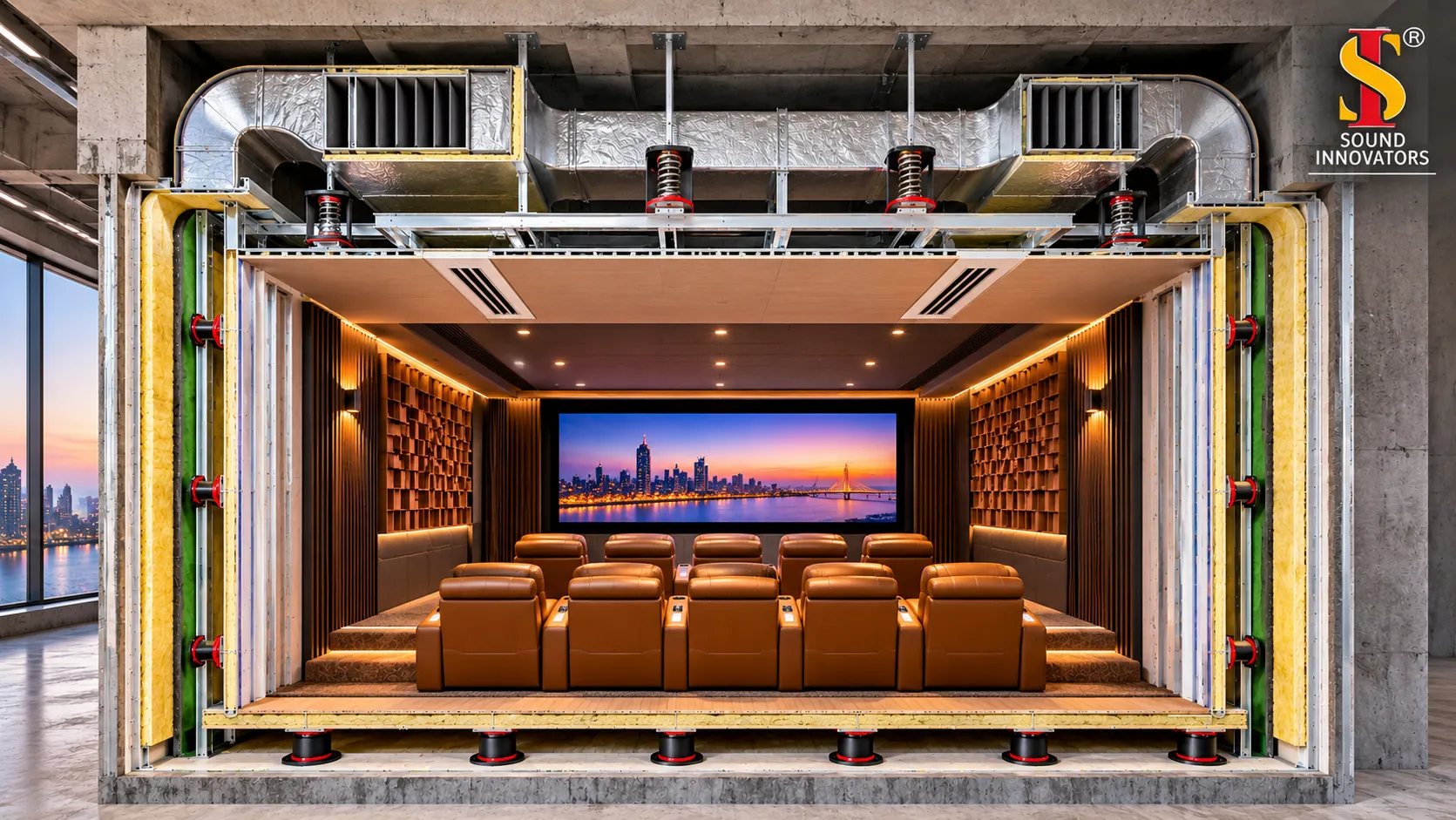
Room-within-a-room acoustic decoupling with spring-isolated ceiling hangers, floating slab pucks, and lined low-velocity HVAC ducts (Sound Innovators, 2026)
Even the finest audio system cannot deliver reference dynamic range if the background noise inside the room is too high, or if you have to turn the volume down at 11:30 PM because 115 dB subwoofer explosions are shaking your children’s bedrooms upstairs. Step 3 addresses the civil and mechanical engineering of the reference private cinema shell.
1. Room-Within-a-Room Structural Decoupling (STC 60+ Isolation)
Sound isolation and room acoustics (interior sound absorption/diffusion) are two completely different physics disciplines. Sound isolation stops sound from entering or leaving the reference private cinema room, and it must be built into the civil shell before any interior panelling starts:
- Floating Floor Slab: Installing elastomeric isolation pucks or high-density neoprene/polymer mats under a secondary screed or engineered timber subfloor to block structural impact and 20 Hz subwoofer transmission into the building’s RCC frame.
- Decoupled Wall Framing: Constructing secondary stud walls mounted on resilient acoustic isolation clips with double layers of high-mass acoustic gypsum board sandwiching viscoelastic Green Glue damping compound.
- Spring-Isolated Acoustic Ceiling: Suspending the false ceiling on calibrated neoprene-in-steel spring hangers so overhead Dolby Atmos energy never vibrates the upper floor slab.
- Acoustic Airlock Doors: Specifying dual-seal solid-core acoustic doors (rated STC 45 to STC 52) with automatic perimeter drop-seals at the threshold.
2. Engineering Whisper-Quiet HVAC (Target Noise Criterion: NC-18 to NC-22)
In Indian villas and penthouses, high ambient temperatures require powerful air conditioning. However, a standard wall-mounted split AC or high-velocity ducted unit generates 38 to 48 dBA of rushing air and compressor noise. That constant mechanical hum masks subtle cinematic details (such as footsteps, whispered dialogue, and ambient rain) and violates CEDIA RP22 background noise targets.
- Remote Fan Coil Unit (FCU) Placement: We relocate the indoor AC blower unit completely outside the reference private cinema envelope (in an adjacent passage or service corridor).
- Internally Lined Acoustic Plenum Ducts: Conditioned air enters the reference private cinema through oversized, acoustically lined sheet-metal ducts with multiple 90-degree baffled turns (acoustic silencers) that reduce air velocity below 250 feet per minute.
- Linear Slot Diffusers & Dedicated Fresh Air: Supply and return vents are positioned away from overhead microphones and seating ears, maintaining a whisper-quiet NC-20 noise floor even during peak Indian summer loads.
Step 4: Baffle Wall Construction, Concealed Acoustic Treatment & Conduit Infrastructure (RIBA Stage 3)
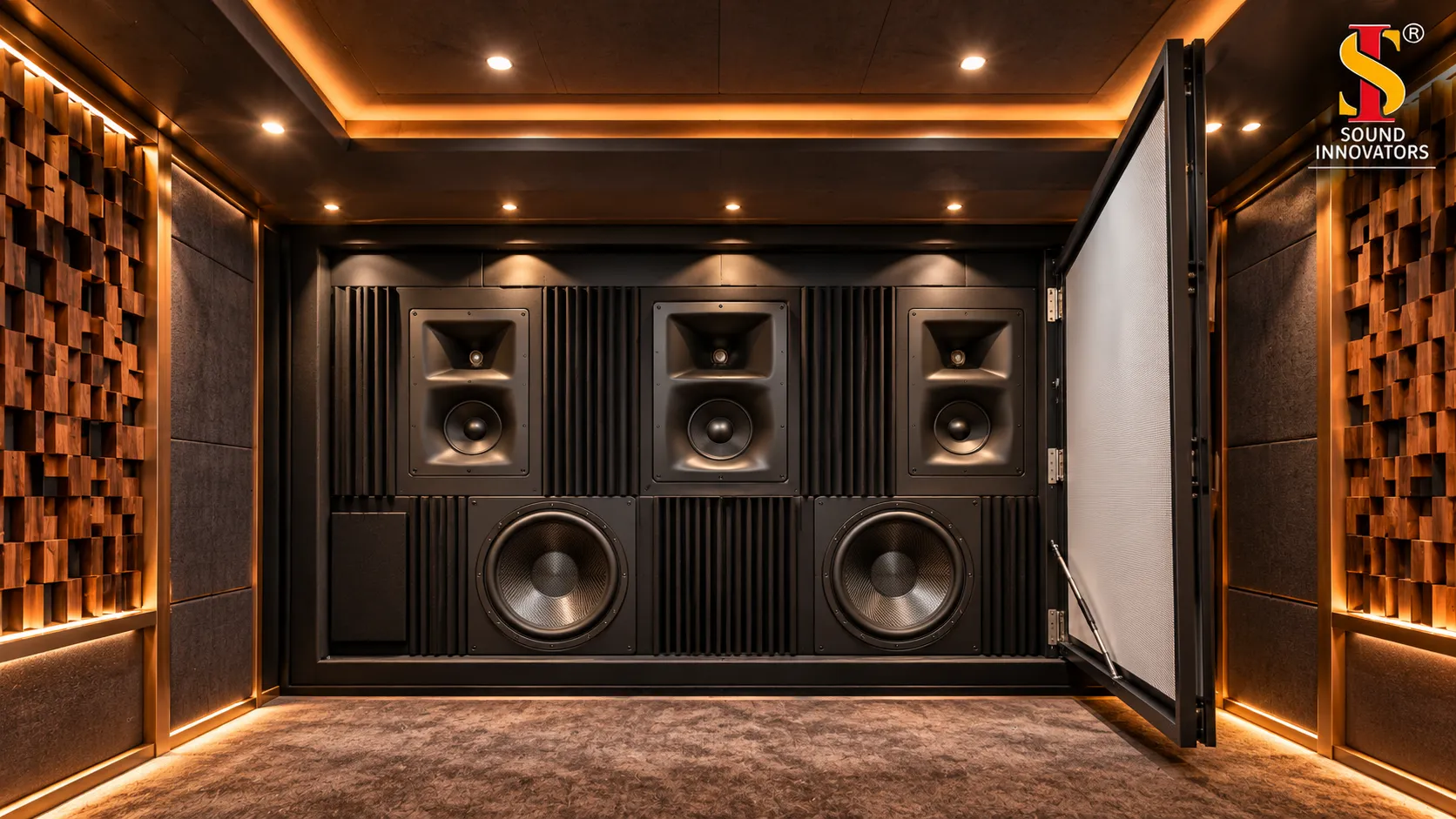
Recessed front baffle wall housing reference LCR speakers and subwoofers behind an acoustically transparent CinemaScope screen (Sound Innovators, 2026)
Once the isolated shell and silent HVAC ducting are in place, Step 4 builds the internal acoustic skeleton and electrical nervous system of the reference private cinema. This is where coordination between Sound Innovators, your interior designer, your electrical contractor, and your carpentry team becomes critical.
1. Front THX / Reference Baffle Wall Engineering
In a commercial cinema or a ₹50L to ₹2Cr+ reference private cinema, you never see giant speaker towers sitting on the floor in front of the screen. Instead, we engineer a false front “baffle wall” behind an acoustically transparent reference private cinema projection screen:
- Flush-Mounted LCR & Subwoofers: The Left, Center, and Right (LCR) reference loudspeakers and front subwoofers are recessed flush into a rigid, heavily damped baffle structure. This eliminates Speaker Boundary Interference Response (SBIR) rear-wall cancellations and boosts low-mid efficiency by up to +6 dB through half-space acoustic loading.
- Pinpoint Dialogue Anchoring: Placing the center channel speaker directly behind the exact vertical and horizontal center of the micro-perforated or woven screen ensures that actors’ voices emerge directly from their lips on screen rather than from below the floor.
2. Measured Interior Acoustic Treatment (Targeting RT60 of 0.25s to 0.35s)
As we highlighted in our recent article on Dolby Atmos Home Cinemas in India: Design, Calibration and Cost Explained, an untreated Indian room with marble floors and plastered brick walls has a reverberation time (RT60) of 1.2 to 2.0 seconds, turning fast movie soundtracks into an unintelligible echo chamber. Equally dangerous is the “local contractor mistake” of covering 100% of the walls in thin 25mm foam or carpet, which deadens high frequencies while leaving 40 Hz to 100 Hz bass completely uncontrolled.
Instead, our Step 4 interior acoustic specification balances three scientifically calculated surfaces behind optically luxurious fabric panels:
- Tuned Corner Diaphragmatic & Membrane Bass Traps: Engineered to absorb high-pressure low-frequency modes between 30 Hz and 120 Hz in all four room corners and wall-ceiling junctions.
- Broadband Velocity Absorbers at First-Reflection Zones: Placed precisely at the sidewall and ceiling mirror points (1 to 8 kHz early reflection zones within the first 0 to 15 milliseconds) to preserve razor-sharp phantom imaging.
- 1D and 2D Quadratic Residue Diffusers (QRD) on Rear & Lateral Walls: Scattering mid-and-high-frequency surround energy across the seating rows so the room sounds spacious, enveloping, and natural without deadening the acoustic atmosphere of the reference private cinema.
3. Structured Cabling, Power Isolation & Thermal Rack Engineering
During Step 4, our engineers issue detailed CAD conduit and electrical schematics to your site electricians:
- Active Optical HDMI 2.1 (48 Gbps+) & Redundant Conduit Pathways: Laying sweep-bend 40mm GI/heavy PVC conduits with pull-cords so future 8K/16K optical cables can be upgraded in 20 minutes without touching finished walls.
- Separated Low-Voltage & High-Voltage Trays: Maintaining a minimum 300mm physical separation between 230V AC power lines, KNX bus cables, CAT6A shielded network lines, and Kordz 12 AWG / 10 AWG oxygen-free copper (OFC) or Kimber Kable speaker lines to eliminate 50 Hz electromagnetic hum.
- Dedicated Clean Earth & Online Double-Conversion Sinewave UPS: Installing dedicated electrical phases with isolation transformers, surge protection, and pure sinewave power conditioning to protect ₹50L+ of sensitive European and American processors from Indian grid voltage spikes.
Step 5: Reference Hardware Specification: Matching Physics to Aesthetics (RIBA Stage 3 to 4)
Notice that hardware selection is Step 5, not Step 1. Only after the room volume, seating distance, acoustic absorption coefficients, and baffle-wall depth are mathematically locked do we specify the exact loudspeakers, processors, amplifiers, and projection optics from our portfolio of 250+ Authorized Luxury Brands.
| Subsystem Category | Engineering Specification Parameter | Reference Brands Specified by Sound Innovators | Why It Matters in a ₹50L to ₹2Cr+ Reference Private Cinema |
|---|---|---|---|
| Immersive Audio Processor (The Brain) | 16 to 32+ discrete channels, 3D remapping, active room mode cancellation | Trinnov Altitude16 / Altitude32, StormAudio ISP Elite MK3, McIntosh MX124 / MX180 | Decodes Dolby Atmos, DTS:X Pro, and Auro-3D while aligning phase, time, and amplitude to sub-millisecond precision |
| Reference Loudspeakers & Subwoofers | High sensitivity (92 to 105 dB/W/m), ultra-low distortion at 105 dB+ continuous SPL, infrasonic bass | Ascendo Immersive Audio, Sonus Faber Arena, Artcoustic, M&K Sound, MAG Theatron, Wisdom Audio, JL Audio Gotham | Effortless dynamic headroom from a pin drop to a 118 dB spacecraft launch without thermal compression |
| Power Amplification | High-current Class-A, Class-AB, or DSP high-damping-factor amplification matched to driver impedance | McIntosh, Trinnov Amplitude, Bryston, Mark Levinson, Rotel, Parsound, Powersoft, StormAudio PA Series | Prevents clipping distortion and maintains ironclad control over large subwoofer and woofer cones |
| Projection & Anamorphic Optics | Native 4K / 8K e-shift laser light engine (2,700 to 10,000+ lumens), DCI-P3 color gamut, motorized 2.39:1 lens | Barco Residential, SIM2 Crystal/Nero, JVC D-ILA NZ800/NZ900, paired with Panamorph Anamorphic Lenses or Lumagen & madVR Video processor | Delivers true CinemaScope widescreen picture with zero black bars and 38% higher pixel brightness |
| Automation, Lighting & Network | Wired bus lighting control, motorized Lutron/Somfy shading, enterprise Wi-Fi & VLAN switching | Crestron, Control4, KNX (official partner), Ruckus ICX Enterprise Networking | One-touch scene execution (“Cinema Premiere”, “Intermission”, “Cleaning Mode”) with zero network lag |
← Scroll table on mobile →
For homeowners located in Western India who want to see how reference private cinema systems integrate with whole-house smart living, read our comprehensive regional guide on Luxury Home Theatre and Smart Home Automation in Mumbai & Pune: A Complete Homeowner’s Guide.
Step 6: Precision Site Integration, Thermal Rack Dressing & Scene Programming (RIBA Stage 5)
Once all dusty civil work, marble polishing, and paint primers are completed on site, Step 6 begins. Our factory-trained installation engineers take over the room to mount, terminate, dress, and program the entire reference private cinema ecosystem.
1. Surgical Transducer Mounting and Laser Alignment
Every in-wall, baffle-wall, and overhead Dolby Atmos speaker is mounted using laser cross-hair inclinometers so that its acoustic dispersion axis points directly at the primary listening cross-section determined in Step 2. Subwoofers and high-output enclosures are mechanically decoupled from the wall studs using calibrated isolation mounts so cabinet energy transfers into the air rather than the framing.
2. Equipment Rack Thermal Engineering and Cable Dressing
A ₹1 crore reference private cinema rack houses processors, multi-channel power amplifiers, media servers (such as Kaleidescape or reference 4K UHD transports), network switches, and power conditioners generating several thousand watts of thermal load.
- We build custom 19-inch Middle Atlantic or bespoke ventilated equipment racks in an adjacent climate-controlled tech closet.
- Every signal, network, and power cable is labeled, Velcro-bundled without crushing dielectric geometry, and routed on separated vertical trays.
- Thermostatically controlled low-noise intake and exhaust fans maintain internal rack temperatures below 28 degrees Celsius, doubling the operational lifespan of sensitive electronics.
3. Intuitive One-Touch Automation Scene Programming
Technology is only truly luxurious when it disappears behind effortless control. Using Crestron, Control4, and KNX integration, we program bespoke scenes tailored to your family’s lifestyle:
- “Premiere Mode” (Single Tap): Architectural covers dim over 8 seconds, motorized blackout blinds seal all glazing, HVAC switches to silent cinema airflow, the anamorphic lens slides into position, and your film begins.
- “Pause / Intermission Mode”: Pressing pause on your handheld remote or tabletop touchscreen gently raises pathway step lights and bar sconces to 15% warm illumination so guests can move safely without ruining night vision.
- “Match Day / Sports Lounge Mode”: Adjusts projector gamma for high-contrast broadcast sports, raises ambient bar lighting to 40%, and engages multi-zone audio synchronization across the adjacent bar and terrace.
Step 7: Measurement-Based Acoustic & Video Calibration (CEDIA/CTA-RP32 Commissioning)
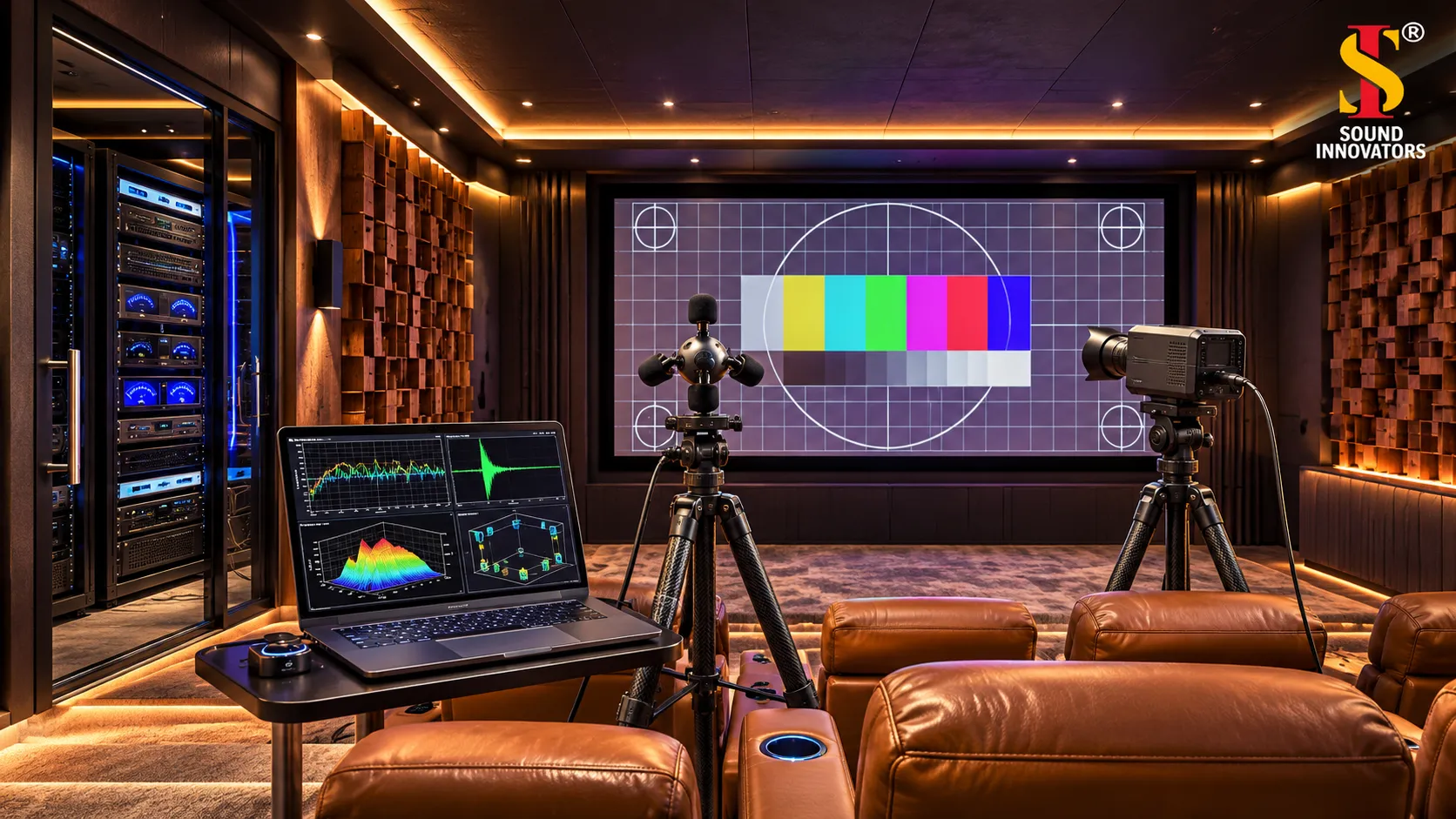
Multi-point 3D tetrahedral microphone calibration and optical spectroradiometer profiling for CEDIA/CTA-RP32 verification (Sound Innovators, 2026)
The seventh and final step is what separates a true reference private cinema from 95% of residential installations in India: objective, multi-microphone scientific calibration and verification. Even the world’s finest equipment is only operating at 50% of its potential when simply plugged in with factory default settings.
1. Multi-Point 3D Acoustic Calibration (Trinnov Optimizer & Dirac Live ART)
Mr. Vijay Yemul and our certified calibration engineers deploy calibrated 3D tetrahedral measurement microphones across every seat in your reference private cinema room. Rather than equalizing a single “money man seat” at the expense of the rest of the family, we measure the impulse response, phase, time arrival, and frequency response across the entire seating area:
- Time & Phase Alignment: Aligning the acoustic arrival time of all 11 to 32+ channels to within 0.1 milliseconds and matching phase across the subwoofer-to-satellite crossover region so bass sounds tight, fast, and seamlessly anchored to the screen.
- 3D Loudspeaker Remapping: Using Trinnov’s patented 3D spatial remapping to measure the exact azimuth and elevation angle of every speaker in your room and dynamically steer Dolby Atmos, DTS:X, and Auro-3D objects to their exact intended coordinates.
- Target House Curve Tuning: Shaping the in-room target curve to avoid harsh 2 kHz to 4 kHz ear fatigue while delivering visceral, distortion-free tactile sub-bass down to 16 Hz.
2. ISF / PVA Optical Video Calibration & Anamorphic Geometry
Simultaneously, our video engineers use laboratory-grade spectroradiometers and colorimeters to calibrate your JVC, SIM2, or Barco laser projector against the exact spectral reflectivity of your projection screen:
- D65 White Balance & Grayscale Tracking: Calibrating RGB grayscale tracking to achieve Delta-E errors under 1.5 (imperceptible to the human eye).
- HDR10+ / Dolby Vision Tone Mapping (Lumagen / madVR): Mapping 1,000-nit to 4,000-nit mastered HDR films to your exact screen foot-lambert (fL) / nit output (targeting 100+ nits for HDR in dedicated dark rooms per CEB23 guidelines) so dark shadow details in films like Dune or The Batman are crystal clear without blowing out bright highlights.
3. CEDIA/CTA-RP32 Verification Report & Annual Maintenance Handover
Finally, we verify the completed system against CEDIA/CTA-RP32 measurement criteria, checking inter-channel SPL consistency, seat-to-seat frequency variance, RT60 decay times, and NCB noise floor. You receive a comprehensive commissioning dossier, full family training, and a preventative Annual Maintenance Contract (AMC) through our Home Theater Design and Installation Services team.
Section 04: Real-World Proof: Flagship Reference Private Cinema Projects in India
When evaluating an AV consultant for a ₹50L to ₹2Cr+ residence, verifiable execution across diverse Indian architectural typologies matters more than brochure promises. Below is a selection of landmark installations from the Sound Innovators Projects Portfolio demonstrating how this 7-step blueprint performs in the real world:
| Flagship Project & Location | System Configuration & Scale | Primary Engineering Challenge Solved |
|---|---|---|
| Malabar Hill, Mumbai – Private 24-Seater Reference Private Cinema | 23.8 Channel Ascendo Dolby Atmos system across 24 custom cinema seats | Engineered multi-row stadium risers, massive distributed subwoofer array, and structural isolation inside one of South Mumbai’s most prestigious residential enclaves |
| Juhu, Mumbai – 30-Seater Commercial-Grade Preview Theatre | Reference 30-Seater Dolby Atmos Preview Theatre | Delivered commercial screening-room SPL uniformity, whisper-quiet high-capacity HVAC, and wide-angle sightlines across 30 seats for industry preview screenings |
| Candolim, Goa – Luxury 5-Suite Beach Mansion | 25.8 Channel Dolby Atmos Cinema + 5-Suite Hi-Fi + Crestron & KNX Whole-Home Automation | Protected ultra-high-end transducers and amplification racks from coastal Goan salinity and humidity while unifying estate-wide lighting, climate, and cinema control |
| Kollam, Kerala – Reference Hi-Fi Library & Reference Private Cinema | 21.6 Channel Dolby Atmos Residence + Dedicated Reference Hi-Fi Listening Library | Designed two acoustically distinct sanctuaries in one estate: a high-SPL 21.6 immersive cinema and a pure, natural two-channel audiophile library |
| Worli, Mumbai & Kartarpur, Punjab – Bespoke Luxury Residences | 7.4.4 Dolby Atmos 6-Seater (Worli) & CEDIA Level 2 12-Seater Reference Private Cinema (Kartarpur) | Achieved reference four-subwoofer bass uniformity and concealed interior aesthetics tailored to both compact high-rise luxury and sprawling North Indian villa footprints |
← Scroll table on mobile →
Section 05: Investment Allocation: Where Your ₹50L to ₹2Cr+ Budget Actually Goes
One of the most common questions wealthy homeowners and their financial advisors ask during Step 1 is how a ₹50 lakh, ₹1 crore, or ₹2 crore+ budget should be distributed across the project. In an amateur retail setup, 90% of the budget is spent on speakers and a projector, leaving almost nothing for room acoustics, isolation, cabling, and calibration.
In contrast, a balanced reference private cinema allocates capital across the complete acoustic and visual signal chain so that no single bottleneck compromises the system:
| Engineering & Hardware Category | Recommended Budget Share | Investment Range (₹60L Reference Private Cinema Build) | Investment Range (₹1.5Cr Ultra-Reference Private Cinema Build) |
|---|---|---|---|
| 1. Acoustic Design, 3D Simulation & RIBA Stage 0 to 6 Consultancy | 8% to 10% (Credited on turnkey purchase) | Included / Adjusted in Turnkey | Included / Adjusted in Turnkey |
| 2. Immersive Loudspeakers & Distributed Subwoofer Array (7.4.4 to 16.6.6) | 32% to 38% | ₹20,00,000 to ₹23,00,000 | ₹48,00,000 to ₹58,00,000 |
| 3. Reference AV Processor & Multi-Channel Power Amplification | 20% to 25% | ₹12,00,000 to ₹15,00,000 | ₹30,00,000 to ₹38,00,000 |
| 4. 4K/8K Laser Projection, Anamorphic Optics & Acoustically Transparent Screen | 18% to 22% | ₹11,00,000 to ₹13,50,000 | ₹27,00,000 to ₹33,00,000 |
| 5. Custom Acoustic Treatment, Baffle Wall & Structural Isolation | 12% to 18% | ₹7,50,000 to ₹10,50,000 | ₹18,00,000 to ₹26,00,000 |
| 6. Thermal Rack, Pure Sinewave Power, Optical Cabling, Automation & RP32 Calibration | 8% to 12% | ₹5,00,000 to ₹7,00,000 | ₹12,00,000 to ₹18,00,000 |
← Scroll table on mobile →
Mumbai High-Rise Penthouses vs. Pune, Goa & Pan-India Luxury Villas
Because Sound Innovators operates from our Mumbai headquarters (Lower Parel) and our Pune regional office (Undri) while executing turnkey reference private cinema projects across India and the Middle East, we adapt our 7-step reference private cinema blueprint to the distinct structural realities of your property type:
- High-Rise Penthouses & Duplexes (Mumbai, Gurugram, Bengaluru): Structural slab-to-slab heights, post-tensioned beams that cannot be core-cut, strict society working hours, and neighbour bass isolation are the primary engineering drivers. Here, we prioritize low-profile spring-isolated ceilings, quad-subwoofer active phase cancellation, and concealed in-wall/baffle architectures.
- Independent Villas, Farmhouses & Holiday Mansions (Pune, Goa, Alibag, Lonavala, Hyderabad, Ludhiana, Chandigarh): Larger room volumes (500 to 1,500+ sq. ft.) and 12 to 18 foot ceiling heights allow multi-row stadium seating and 9.4.6 to 25.8 channel configurations. However, these estates require high-sensitivity compression-driver loudspeakers to pressurize large air volumes, dedicated three-phase electrical conditioning, and climate-controlled equipment rooms.
Frequently Asked Questions (FAQs) About Building a Reference Private Cinema
When is the right stage to hire a consultant for a reference private cinema in India?
You should engage a certified AV consultant during RIBA Stage 0 to Stage 2 (the architectural blueprint or bare-shell stage), before room dimensions, brick walls, HVAC ducting, and false ceiling heights are finalized. Bringing Sound Innovators in before civil and interior work begins prevents ₹6.5 lakhs to ₹17.5 lakhs in post-construction demolition and rework.
Why does Sound Innovators charge a 10% consultancy and simulation fee?
True acoustic engineering requires days of physics calculations, 3D modal simulation, CAD conduit drawings, baffle-wall detailing, and sightline engineering before a single product is ordered. We charge 10% of the estimated system cost for this comprehensive engineering study, and 100% of that consultancy fee is adjusted (credited back) into your final invoice when you procure the turnkey system through us within four months.
What is the minimum room size required for a 7.4.4 or 9.4.6 Dolby Atmos reference private cinema?
For a dedicated two-row (6 seat) reference private cinema running a 7.4.4 Dolby Atmos configuration, we recommend a minimum raw shell dimension of 23 ft (Length) x 14 ft (Width) x 11 ft (Height). For a three-row (12 to 18 seat) 9.4.6 or higher configuration, an ideal raw shell ranges from 26 to 34 ft (Length) x 17 to 22 ft (Width) x 12 to 15 ft (Height).
Why are four subwoofers (.4) recommended instead of one or two large subwoofers?
In a closed concrete reference private cinema room, a single powerful subwoofer excites strong standing waves, making bass boomy in corners and weak in the middle of the room. Using four calibrated subwoofers (a 7.4.4 or 9.4.4 array) is not about making the room four times louder; it is about cancelling room modes & null points so every viewer across every seating row hears identical, tight, articulate bass. Also for trinnov waveforming 4 subwoofers are recommended.
Can a reference private cinema be completely concealed inside a luxury interior design?
Yes. Through our invisible integration methodology, 100% of the loudspeakers, subwoofers, bass traps, and wiring are concealed behind acoustically transparent architectural fabrics, custom wood slats, and false baffle walls. Your interior designer retains complete control over the visual palette while our engineers guarantee zero acoustic loss behind the fabric.
How long does the 7-step turnkey engineering and installation process take?
Steps 1 and 2 (floor-plan audit, 3D acoustic simulation, and CAD engineering drawings) typically take 2 to 4 weeks. Steps 3 and 4 run alongside your civil, HVAC, and interior fit-out schedule over 8 to 20 weeks. Finally, Steps 6 and 7 (equipment rack integration, speaker mounting, automation programming, and Trinnov/RP32 calibration) require 2 to 4 weeks once the reference private cinema room is dust-free.
Do you supply individual speakers or match online discount quotes?
No. Sound Innovators is an independent engineering consultancy and turnkey systems integrator, not a retail box-mover. Because an uncalibrated speaker in an untreated room cannot deliver reference private cinema performance, we focus exclusively on complete, engineered turnkey projects and private consultations by appointment only. If someone is looking for cross-quoting, heavy discounts, or uncalibrated hardware sales, we are not the right fit.
Do Sound Innovators execute projects outside Mumbai and Pune?
Yes. While our headquarters is in Lower Parel, Mumbai, and our regional office is in Undri, Pune, our engineering and commissioning teams execute luxury home theatres in India across Goa, Delhi NCR, Bengaluru, Hyderabad, Ahmedabad, Surat, Ludhiana, Chandigarh, Chennai, Kerala, and select international projects in Dubai and the Middle East.
Conclusion & Next Step: Submit Your Floor Plan for a RIBA Stage 0 to 2 Feasibility Study
Commissioning a reference private cinema is a generational investment in how your family experiences cinema, music, and togetherness at home. When you follow a disciplined 7-step engineering blueprint from bare shell to final calibration, technology disappears into the architecture, leaving only pure emotional immersion.
If you are an ultra-HNI homeowner, principal architect, or luxury interior designer planning a residence with an estimated AV and cinema investment of ₹35 Lakhs to ₹2 Crores+, do not wait until your false ceilings and wall panelling are locked.
Ready to Engineer Your Reference Private Cinema Sanctuary?
- Step 1: Share your architectural floor plan (PDF or AutoCAD DWG) and room dimensions with our engineering team.
- Step 2: Schedule a private, by-appointment discovery session at our Mumbai Head Office or Pune Regional Office (or via virtual architectural review for pan-India and Middle East estates).
- Book Your Private Consultation: Visit our Consultancy & Floor-Plan Review Page or reach out directly via our Private Appointment Contact Page.
- Direct Engineering Desk: Call +91 99232 88899 or email your floor plans to info@soundinnovators.in.